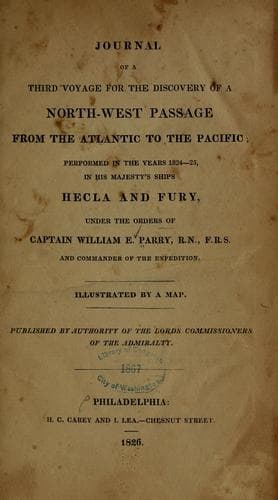
Journal of the Third Voyage for the Discovery of a North-West PassageParry, William Edward, Sir
History
Journal of the Third Voyage for the Discovery of a North-West Passage
Parry, William Edward, Sir
Arctic regions -- Discovery and exploration -- British; Fury (Ship); Hecla (Ship); Northwest Passage
thus reversing in this respect also the usual order of things. It was
moreover observed that the clouds were frequently coming from the
north-west, when the wind in Port Bowen was easterly. I must, however,
except the gales we experienced from the eastward, which were probably
strong enough to overcome any local deflection to which a light breeze
would be subject; and indeed these were always accompanied with overcast
weather and a high thermometer. After the middle of October the gales of
wind were very few till towards the middle of April, when we experienced
more blowing weather than during the whole winter.
CHAPTER IV.
Meteorological Phenomena continued—Re-equipment of the Ships—Several
Journeys undertaken—Open Water in the Offing—Commence sawing a Canal to
liberate the Ships—Disruption of the Ice—Departure from Port Bowen.
The height of the land about Port Bowen deprived us longer than usual of
the sun’s presence above our horizon. Some of our gentlemen, indeed, who
ascended a high hill for the purpose, caught a glimpse of him on the 2nd
of February; on the 15th it became visible at the observatory, but at the
ships not till the 22nd, after an absence of one hundred and twenty-one
days. It is very long after the sun’s reappearance in these regions,
however, that the effect of his rays, as to warmth, becomes perceptible;
week passes after week with scarcely any rise in the thermometer except
for an hour or two during the day; and it is at this period more than any
other, perhaps, that the lengthened duration of a polar winter’s cold is
most wearisome, and creates the most impatience. Towards the third week
in March, thin flakes of snow lying upon black painted wood or metal, and
exposed to the sun’s direct rays in a sheltered situation, readily
melted. In the second week of April any very light covering of sand or
ashes upon the snow close to the ships might be observed to make its way
downward into holes; but a coat of sand laid upon the unsheltered ice, to
the distance of about two-thirds of a mile, for dissolving a canal to
hasten our liberation, produced no such sensible effect till the
beginning of May. Even then the dissolution was very trifling till about
the first week in June, when pools of water began to make their
appearance, and not long after this a small boat would have floated down
it. On shore the effect is in general still more tardy, though some
deception is there occasioned by the dissolution of the snow next the
ground, while its upper surface is to all appearance undergoing little or
no change. Thus a greater alteration is sometimes produced in the aspect
of the land by a single warm day in an advanced part of the season than
in many weeks preceding, in consequence of the last crust of snow being
dissolved, leaving the ground at length entirely bare. We could now
perceive the snow beginning to leave the stones from day to day as early
as the last week in April.
Public-domain text, read in full here on John Shaqi.
Reviews
Reviews
No reviews yet
Be the first to share your thoughts on this work.
Join the Discussion
Join the discussion
Sign in to leave a comment or review.
Sign InorCreate an account