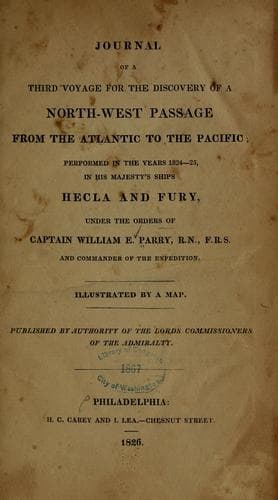
Journal of the Third Voyage for the Discovery of a North-West PassageParry, William Edward, Sir
History
Journal of the Third Voyage for the Discovery of a North-West Passage
Parry, William Edward, Sir
Arctic regions -- Discovery and exploration -- British; Fury (Ship); Hecla (Ship); Northwest Passage
Towards the end of May a great deal of snow
was dissolved daily, but owing to the porous nature of the ground, which
absorbed it as fast as it was formed, it was not easy to procure water
for drinking on shore, even as late as the 10th of June. In the ravines,
however, it could be heard trickling under stones before that time, and
about the 18th, many considerable streams were formed, and constantly
running both night and day. After this, the thawing proceeded at an
inconceivably rapid rate, the whole surface of the floes being covered
with large pools of water rapidly increasing in size and depth.
We observed nothing extraordinary with respect to the sun’s light about
the shortest day; but as early as the 20th of November Arcturus could
very plainly be distinguished by the naked eye, when near the south
meridian at noon. About the first week in April the reflection of light
from the snow became so strong as to create inflammation in the eyes, and
notwithstanding the usual precaution of wearing black crape veils during
exposure, several cases of snow-blindness occurred shortly afterwards.
There are perhaps few things more difficult to obtain than a comparative
measure of the quantity of snow that falls at different places, owing to
the facility with which the wind blows it off a smooth surface, such as a
floe of level ice, and the collection occasioned by drift in consequence
of the smallest obstruction. Thus, its mean depth at Port Bowen,
measured in twenty different places on the smooth ice of the harbour, was
three inches on the 5th of April, and on the 1st of May it had only
increased to four and a half inches, while an immense bank, fourteen feet
deep, had formed on one side of the _Hecla_, occasioned by the heavy
drifts. The crystals were, as usual, extremely minute during the
continuance of the cold weather, and more or less of these were always
falling, even on the clearest days.
The animals seen at Port Bowen may now be briefly noticed. The principal
of those seen during the winter were bears, of which we killed twelve,
from October to June, being more than during all the other voyages taken
together; and several others were seen. One of these animals was near
proving fatal to a seaman of the _Fury_, who, having straggled from his
companions, when at the top of a high hill saw a large bear coming
towards him. Being unarmed, he prudently made off, taking off his boots
to enable him to run the faster, but not so prudently precipitated
himself over an almost perpendicular cliff, down which he was said to
have rolled or fallen several hundred feet; here he was met by some of
the people in so lacerated a condition as to be in a very dangerous state
for some time after.
Public-domain text, read in full here on John Shaqi.
Reviews
Reviews
No reviews yet
Be the first to share your thoughts on this work.
Join the Discussion
Join the discussion
Sign in to leave a comment or review.
Sign InorCreate an account