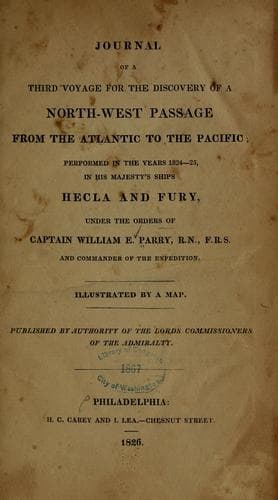
Journal of the Third Voyage for the Discovery of a North-West Passage — John Shaqi
Journal of the Third Voyage for the Discovery of a North-West PassageParry, William Edward, Sir
History
Journal of the Third Voyage for the Discovery of a North-West Passage
Parry, William Edward, Sir
Arctic regions -- Discovery and exploration -- British; Fury (Ship); Hecla (Ship); Northwest Passage
The ships standing in towards Lievely on the afternoon of the 5th,
Lieutenant Graah very kindly came off to the _Fury_, which happened to be
the nearest in shore, for the purpose of taking leave of us. On his
quitting the ship a salute of ten guns was fired at Lievely, which we
returned with an equal number; and I sent to Lieutenant Graah, by a canoe
that came on board the _Hecla_, an account of the situation of the rocks
we had discovered. Light northerly winds, together with the dull sailing
of our now deeply laden ships, prevented our making much progress for
several days, and kept us in the neighbourhood of numerous icebergs,
which it is dangerous to approach when there is any swell. We counted
from the deck, at one time, no less than one hundred and three of these
immense bodies, some of them from one to two hundred feet in height above
the sea; and it was necessary, in one or two instances, to tow the ships
clear of them with the boats. We had occasion, about this time, to
remark the more than usual frequency of fogs with a northerly wind, a
circumstance from which the whalers are accustomed to augur a
considerable extent of open water in that direction.
The ice soon beginning to close around us, our progress became so slow
that, on the 17th, we saw a ship at the margin of the “pack,” and two
more on the following day. We supposed these to be whalers, which, after
trying to cross the ice to the northward, had returned to make the
attempt in the present latitude; a supposition which our subsequent
difficulties served to strengthen. From this time, indeed, the
obstructions from the quantity, magnitude, and closeness of the ice, were
such as to keep our people almost constantly employed in heaving,
warping, or sawing through it; and yet with so little success that, at
the close of the month of July, we had only penetrated seventy miles to
the westward, or to the longitude of about 62° 10′. Here, while closely
beset, on the 1st of August, we encountered a hard gale from the
south-east, which pressing the ice together in every direction, by mass
overlaying mass for hours together, the _Hecla_ received several very
awkward “nips,” and was once fairly laid on her broadside by a strain
which must inevitably have crushed a vessel of ordinary strength. In
such cases, the ice is forced under a ship’s bottom on one side, and on
the other up her side, both powers thus acting in such a manner as to
bring her on her “beam-ends.” This is, in fact, the most favourable
manner in which a ship can receive the pressure, and would perhaps only
occur with ice comparatively not very heavy, though sufficiently so, it
is said, to have run completely over a ship in some extreme and fatal
cases. With ice of still more formidable dimensions a vessel would
probably, by an equal degree of pressure, be absolutely crushed, in
consequence of the increased difficulty of sinking it on one side, and
causing it to rise on the other.
Public-domain text, read in full here on John Shaqi.
Reviews
Reviews
No reviews yet
Be the first to share your thoughts on this work.
Join the Discussion
Join the discussion
Sign in to leave a comment or review.
Sign InorCreate an account