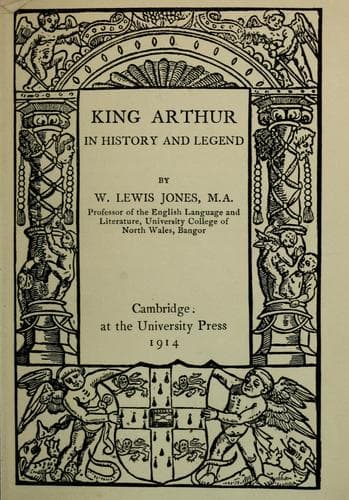
King Arthur in history and legendJones, William Lewis
History
King Arthur in history and legend
Jones, William Lewis
Arthur, King; Arthurian romances -- History and criticism
_Kulhwch and Olwen_, the most fantastic of all the Welsh prose tales
dealing with Arthur, palpably embodies Arthurian traditions current
in Wales at a very early date. “Almost every page of this tale,”
writes Matthew Arnold,[58] “points to traditions and personages of
the most remote antiquity, and is instinct with the very breath of
the primitive world.” The tale relates of the wooing of Olwen, the
daughter of one bearing the formidable name of Yspaddaden Pen Kawr, by
Kulhwch, so called because “he had been found in a swine’s burrow,”
but “nevertheless a boy of gentle lineage, and cousin unto Arthur.”
Kulhwch, after being told by his stepmother that he “should never
have a wife until he obtained Olwen,” is informed by his father that
“that will be easy for him.” “Arthur is thy cousin,” the father says;
“go, therefore, unto Arthur, to cut thy hair, and ask this of him as
a boon.” The winning of Olwen,--hard enough though it appears in the
story, which is mainly concerned with the long series of laborious
tasks imposed upon Kulhwch as conditions of gaining her hand--is
made “easy” through Arthur’s intervention. The hero starts by duly
presenting himself at “the gate of Arthur’s palace,” and he there meets
with the porter, Glewlwyd of the Mighty Grasp, who conveys to Arthur
the news of his arrival. Arthur is introduced to us as the head of
a court, keeping high state in his palace, or hall, which is called
Ehangwen (Broad-White). When Kulhwch comes to ask his “boon” of him,
Arthur replies, “Thou shalt receive the boon whatsoever thy tongue may
name, as far as the wind dries, and the rain moistens, and the sun
revolves, and the sea encircles, and the earth extends,--save only my
ship; and my mantle; and Caledvwlch,[59] my sword; and Rhongomyant, my
lance; and Wynebgwrthucher, my shield; and Carnwennan, my dagger; and
Gwenhwyvar, my wife.” Kulhwch proceeds to ask for help in his quest
not only from Arthur himself, but also from his knights and retainers,
of whom a long and weird list is given. Kai and Bedwyr--an apparently
inseparable pair--are first mentioned; then follows a series of strange
and fantastic names, of most of which no other record remains in
fable or folk-lore. Characters such as Taliesin, the chief of bards;
Manawyddan, son of Llŷr; Gereint, son of Erbin; Gwynn, the son of Nudd,
and some others, are heard of elsewhere. But what are we to make of
beings like Sugyn, the son of Sugnedydd, “who could suck up the sea
on which were three hundred ships, so as to leave nothing but a dry
strand”; or, “Gilla of the Deer-Legs, the chief-leaper of Ireland,”
who “would clear three hundred acres at one bound”; or, Gwevyl, the
son of Gwestad, who, “on the day that he was sad, would let one of
his lips drop below his waist, while he turned up the other like a
cap upon his head”; or, Medyr, the son of Methredydd, who could from
Cornwall “unerringly shoot the wren through the two legs” as far away
Public-domain text, read in full here on John Shaqi.
Reviews
Reviews
No reviews yet
Be the first to share your thoughts on this work.
Join the Discussion
Join the discussion
Sign in to leave a comment or review.
Sign InorCreate an account