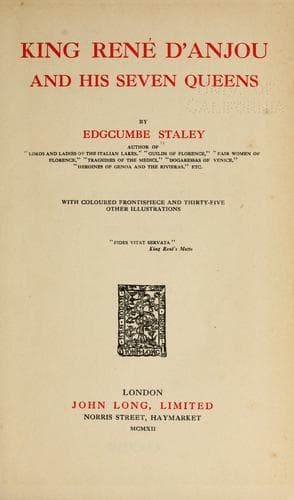
King René d'Anjou and His Seven QueensStaley, Edgcumbe
History
King René d'Anjou and His Seven Queens
Staley, Edgcumbe
France -- Court and courtiers; René I, King of Naples and Jerusalem, 1409-1480
Within the courtyard, about the royal apartments, and all through
the precincts of the Presence, minstrels and poets thronged, as well as
Ministers and officials; Queen Yolanda was the Queen of Troubadours,
and the courtiers she loved best to have about her were merry maids
and men--graduates of the “_Gaya Ciencia_.” The livelong night they
had danced and postured, they had piped and sung. Each poet of the
hilarious company had in turn taken up his recitative, printed by
staccato notes, to be repeated in chorus and in step, until the
_fandangoes_ and _boleros_ of the South were turned into the boisterous
whirling _jotas_ of Aragon. The first dawn of day brought into play
lutes and harps, restrung, retuned cellos and hurdy-gurdies, and
_vihuelas de peñola_, guitars with metal wires and struck with strong
herons’ plumes, and so awoke the phlegmatic guardians of the castle.
Sweet and harmonious Provençal voices blended with soft notes of
melodious singers from Languedoc to the running accompaniment of the
weird Basque music of the mountaineers.
The Queen, upon her massive curtained bed of state, heard the refrains
and felt the vibration of the lilting measures, and smiled pleasantly
as she laid awake expectantly. At length the great tenor bell up in
the chapel turret gave out the hour of six. The last note seemed to
hang, and many a devout listener bent a reverent knee and bared his
head, whilst the women-folk uttered fervent _Aves_. One single stroke
of the metal clapper was followed, alas! immediately by another. “Two
for a Princess!” resounded from lusty throats, but there was a tone of
disappointment in the cry. The glaring morning sun, however, made no
mistake, impartial in his love of sex. Dancing upon the phosphorescent
ripples of the rolling Mediterranean, he shot golden beams within the
royal chamber, and crimson flushed the cheeks of the royal mother
and her child. It was the red-hot sun of Spain, and the day was red,
too--the feast of San Marco, April 25, 1380.
Christened within eight hours of birth--the custom in Aragon--and
“Yolanda” named, the little Princess’s advent was speeded right away
to distant Barrois, her mother’s home, by the Queen’s Chamberlain,
trusty Cavalier Hugues de Pulligny. He had been summoned at once to the
accouchement couch, and given to hold and identify the babe. With him
he took the Queen’s mothering scarf--the token of a happy birth--and
hied post-haste to lay it and his news at the feet of the anxious Duke
and Duchess at Bar-le-Duc. His reward was a patent of nobility and 500
good golden livres.
Public-domain text, read in full here on John Shaqi.
Reviews
Reviews
No reviews yet
Be the first to share your thoughts on this work.
Join the Discussion
Join the discussion
Sign in to leave a comment or review.
Sign InorCreate an account