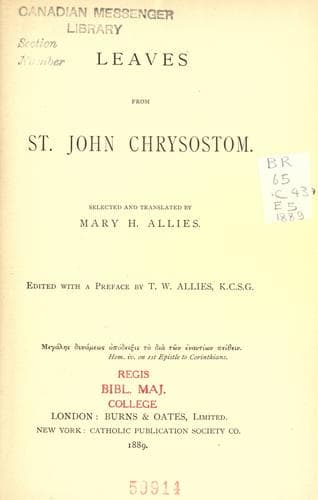
Leaves from St. John ChrysostomJohn Chrysostom, Saint
Religion
Leaves from St. John Chrysostom
John Chrysostom, Saint
Christian literature, Early; John Chrysostom, Saint, -407
The body, therefore, of him who spoke these words, while a preacher at
Antioch, rests more fitly than in any other place amid that matchless
group of apostles, saints, and martyrs which surrounds the body of the
Fisherman, in the central shrine of Christendom. There he awaits the
sight which he anticipated with so much joy.
I must notice one more fact of the eight great brethren, the chief
doctors of the East and West. St. Ambrose, St. Jerome, St. Augustine,
St. Gregory the Great, St. Athanasius, St. Basil, St. Gregory Nazianzen,
and himself, all suffered persecution; the life of St. Athanasius was
for years in danger from the bitter hatred of the emperor Constantius,
and the emperor Valens would have destroyed St. Basil, had he dared. But
to Chrysostom alone was given actually to lay down his life itself for
justice’ sake, and to follow St. John the Baptist not only in sanctity
of life and preaching the cross of Christ, but in his death through the
persecution of a woman, and the blinded tyranny of a king devoted to her
will.
Summary of his Works
It may be well to give here a summary of St. Chrysostom’s works. Very
much of his labour he spent in commenting upon Scripture. This took the
form of homilies, of which the larger part was delivered before the
people in Antioch. He belongs to the Antiochene school of literal
explanation. He was a fellow-pupil under Diodorus of Tarsus, with that
Theodorus, afterwards bishop of Mopsuestia, whose writings were the
fountain-head of what was afterwards called Nestorianism. They were
composed exactly at the same time as those of St. Augustine, and were as
prolific for evil as those of St. Augustine for good. But the piety and
accurate doctrine of St. Chrysostom preserved him from the errors of his
early comrade and friend. His homilies in their structure may be divided
into the careful expounding of the text, even to its particles, and then
the moral application, both in popular yet scientific form, finished
with such skill that the art of eloquence seems blended with that of
exposition in the fairest union.
Public-domain text, read in full here on John Shaqi.
Reviews
Reviews
No reviews yet
Be the first to share your thoughts on this work.
Join the Discussion
Join the discussion
Sign in to leave a comment or review.
Sign InorCreate an account