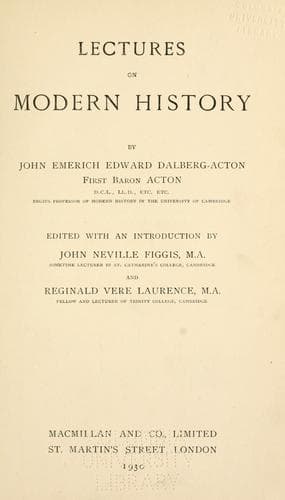
Lectures on Modern historyActon, John Emerich Edward Dalberg Acton, Baron
History
Lectures on Modern history
Acton, John Emerich Edward Dalberg Acton, Baron
History, Modern
Apart from what is technical, method is only the reduplication of
common sense, and is best acquired by observing its use by the
ablest men in every variety of intellectual employment #70. Bentham
acknowledged that he learned less from his own profession than
from writers like Linnaeus and Cullen; and Brougham advised the
student of Law to begin with Dante. Liebig described his Organic
Chemistry as an application of ideas found in Mill's Logic, and a
distinguished physician, not to be named lest he should overhear
me, read three books to enlarge his medical mind; and they were
Gibbon, Grote, and Mill. He goes on to say, "An educated man
cannot become so on one study alone, but must be brought under
the influence of natural, civil, and moral modes of thought." #71
I quote my colleague's golden words in order to reciprocate them.
If men of science owe anything to us, we may learn much from them
that is essential #72. For they can show how to test proof, how to
secure fulness and soundness in induction, how to restrain and to
employ with safety hypothesis and analogy. It is they who hold
the secret of the mysterious property of the mind by which error
ministers to truth, and truth slowly but irrevocably prevails #73.
Theirs is the logic of discovery #74, the demonstration of the
advance of knowledge and the development of ideas, which as the
earthly wants and passions of men remain almost unchanged, are
the charter of progress and the vital spark in history. And they
often give us invaluable counsel when they attend to their own
subjects and address their own people. Remember Darwin taking
note only of those passages that raised difficulties in his way;
the French philosopher complaining that his work stood still,
because he found no more contradicting facts; Baer, who thinks
error treated thoroughly nearly as remunerative as truth, by the
discovery of new objections; for, as Sir Robert Ball warns us, it
is by considering objections that we often learn #75. Faraday
declares that "in knowledge, that man only is to be condemned and
despised who is not in a state of transition." And John Hunter
spoke for all of us when he said: "Never ask me what I have said
or what I have written; but if you will ask me what my present
opinions are, I will tell you."
Public-domain text, read in full here on John Shaqi.
Reviews
Reviews
No reviews yet
Be the first to share your thoughts on this work.
Join the Discussion
Join the discussion
Sign in to leave a comment or review.
Sign InorCreate an account