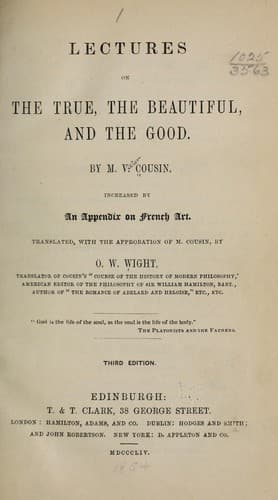
Lectures on the true, the beautiful and the goodCousin, Victor
Philosophy
Lectures on the true, the beautiful and the good
Cousin, Victor
Aesthetics; Ethics; Truth
Principle on which true theodicea rests. God the last foundation
of moral truth, of the good, and of the moral person.--Liberty
of God.--The divine justice and charity.--God the sanction of
the moral law. Immortality of the soul; argument from merit and
demerit; argument from the simplicity of the soul; argument from
final causes.--Religious sentiment.--Adoration.--Worship.--Moral
beauty of Christianity.
LECTURE XVII.--RESUME OF DOCTRINE 346
Review of the doctrine contained in these lectures, and the
three orders of facts on which this doctrine rests, with the
relation of each one of them to the modern school that has
recognized and developed it, but almost always exaggerated
it.--Experience and empiricism.--Reason and idealism.--Sentiment
and mysticism.--Theodicea. Defects of different known
systems.--The process that conducts to true theodicea, and the
character of certainty and reality that this process gives to
it.
APPENDIX 371
LECTURES
ON
THE TRUE, THE BEAUTIFUL, AND THE GOOD.
DISCOURSE
PRONOUNCED AT THE OPENING OF THE COURSE,
DECEMBER 4, 1817.
PHILOSOPHY IN THE NINETEENTH CENTURY.
Spirit and general principles of the Course.--Object of the
Lectures of this year:--application of the principles of which
an exposition is given, to the three Problems of the True, the
Beautiful, and the Good.
It seems natural that a century, in its beginning, should borrow its
philosophy from the century that preceded it. But, as free and
intelligent beings, we are not born merely to continue our predecessors,
but to increase their work, and also to do our own. We cannot accept
from them an inheritance except under the condition of improving it. Our
first duty is, then, to render to ourselves an account of the philosophy
of the eighteenth century; to recognize its character and its
principles, the problems which it agitated, and the solutions which it
gave of them; to discern, in fine, what it transmits to us of the true
and the productive, and what it also leaves of the sterile and the
false, in order that, with reflective choice, we may embrace the former
and reject the latter.[3] Placed at the entrance of the new times, let
us know, first of all, with what views we would occupy ourselves.
Moreover,--why should I not say it?--after two years of instruction, in
which the professor, in some sort, has been investigating himself, one
has a right to demand of him what he is; what are his most general
principles on all the essential parts of philosophic science; what flag,
in fine, in the midst of parties which contend with each other so
violently, he proposes for you, young men, who frequent this auditory,
and who are called upon to participate in a destiny still so uncertain
and so obscure in the nineteenth century, to follow.
Public-domain text, read in full here on John Shaqi.
Reviews
Reviews
No reviews yet
Be the first to share your thoughts on this work.
Join the Discussion
Join the discussion
Sign in to leave a comment or review.
Sign InorCreate an account