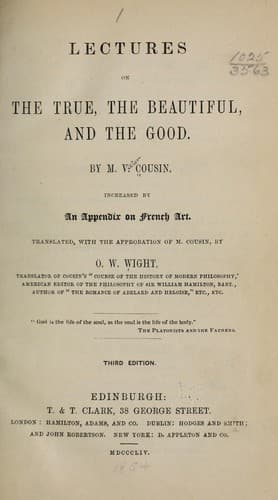
Lectures on the true, the beautiful and the goodCousin, Victor
Philosophy
Lectures on the true, the beautiful and the good
Cousin, Victor
Aesthetics; Ethics; Truth
Extent of the question of the good.--Position of the question
according to the psychological method: What is, in regard to the
good, the natural belief of mankind?--The natural beliefs of
humanity must not be sought in a pretended state of nature.--
Study of the sentiments and ideas of men in languages, in life,
in consciousness.--Disinterestedness and devotedness.--Liberty.--
Esteem and contempt.--Respect.--Admiration and indignation.--
Dignity.--Empire of opinion.--Ridicule.--Regret and repentance.--
Natural and necessary foundations of all justice.--Distinction
between fact and right.--Common sense, true and false philosophy.
LECTURE XII.--THE ETHICS OF INTEREST 229
Exposition of the doctrine of interest.--What there is of truth
in this doctrine.--Its defects. 1st. It confounds liberty and
desire, and thereby abolishes liberty. 2d. It cannot explain the
fundamental distinction between good and evil. 3d. It cannot
explain obligation and duty. 4th. Nor right. 5th. Nor the
principle of merit and demerit.--Consequences of the ethics of
interest: that they cannot admit a providence, and lead to
despotism.
LECTURE XIII.--OTHER DEFECTIVE PRINCIPLES 255
The ethics of sentiment.--The ethics founded on the principle of
the interest of the greatest number.--The ethics founded on the
will of God alone.--The ethics founded on the punishments and
rewards of another life.
LECTURE XIV.--TRUE PRINCIPLES OF ETHICS 274
Description of the different facts that compose the moral
phenomena.--Analysis of each of these facts:--1st, Judgment and
idea of the good. That this judgment is absolute. Relation
between the true and the good.--2d, Obligation. Refutation of
the doctrine of Kant that draws the idea of the good from
obligation instead of founding obligation on the idea of the
good.--3d, Liberty, and the moral notions attached to the notion
of liberty.--4th, Principle of merit and demerit. Punishments
and rewards.--5th, Moral sentiments.--Harmony of all these facts
in nature and science.
LECTURE XV.--PRIVATE AND PUBLIC ETHICS 301
Application of the preceding principles.--General formula of
interest,--to obey reason.--Rule for judging whether an action
is or is not conformed to reason,--to elevate the motive of this
action into a maxim of universal legislation.--Individual
ethics. It is not towards the individual, but towards the moral
person that one is obligated. Principle of all individual
duties,--to respect and develop the moral person.--Social
ethics,--duties of justice and duties of charity.--Civil
society. Government. Law. The right to punish.
LECTURE XVI.--GOD THE PRINCIPLE OF THE IDEA OF THE GOOD 325
Public-domain text, read in full here on John Shaqi.
Reviews
Reviews
No reviews yet
Be the first to share your thoughts on this work.
Join the Discussion
Join the discussion
Sign in to leave a comment or review.
Sign InorCreate an account