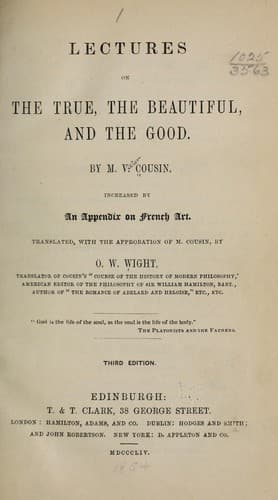
Lectures on the true, the beautiful and the goodCousin, Victor
Philosophy
Lectures on the true, the beautiful and the good
Cousin, Victor
Aesthetics; Ethics; Truth
* * * * *
It is not patriotism, it is a profound sentiment of truth and justice,
which makes us place the whole philosophy now expanded in the world
under the invocation of the name of Descartes. Yes, the whole of modern
philosophy is the work of this great man, for it owes to him the spirit
that animates it, and the method that constitutes its power.
After the downfall of scholasticism and the mournful disruptures of the
sixteenth century, the first object which the bold good sense of
Descartes proposed to itself was to make philosophy a human science,
like astronomy, physiology, medicine, subject to the same uncertainties
and to the same aberrations, but capable also of the same progress.
Descartes encountered the skepticism spread on every side in the train
of so many revolutions, ambitious hypotheses, born out of the first use
of an ill-regulated liberty, and the old formulas surviving the ruins of
scholasticism. In his courageous passion for truth, he resolved to
reject, provisorily at least, all the ideas that hitherto he had
received without controlling them, firmly decided not to admit any but
those which, after a serious examination, might appear to him evident.
But he perceived that there was one thing which he could not reject,
even provisorily, in his universal doubt,--that thing was the existence
itself of his doubt, that is to say, of his thought; for although all
the rest might be only an illusion, this fact, that he thought, could
not be an illusion. Descartes, therefore, stopped at this fact, of an
irresistible evidence, as at the first truth which he could accept
without fear. Recognizing at the same time that thought is the necessary
instrument of all the investigations which he might propose to himself,
as well as the instrument of the human race in the acquisition of its
natural knowledges,[4] he devoted himself to a regular study of it, to
the analysis of thought as the condition of all legitimate philosophy,
and upon this solid foundation he reared a doctrine of a character at
once certain and living, capable of resisting skepticism, exempt from
hypotheses, and affranchised from the formulas of the schools.
Thus the analysis of thought, and of the mind which is the subject of
it, that is to say, psychology, has become the point of departure, the
most general principle, the important method of modern philosophy.[5]
Public-domain text, read in full here on John Shaqi.
Reviews
Reviews
No reviews yet
Be the first to share your thoughts on this work.
Join the Discussion
Join the discussion
Sign in to leave a comment or review.
Sign InorCreate an account