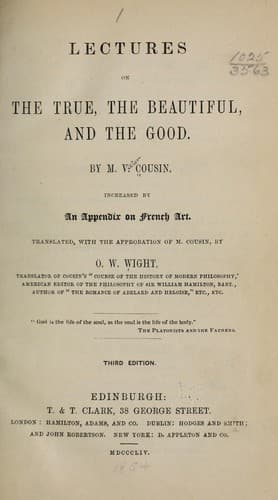
Lectures on the true, the beautiful and the goodCousin, Victor
Philosophy
Lectures on the true, the beautiful and the good
Cousin, Victor
Aesthetics; Ethics; Truth
Nevertheless, it must indeed be owned, philosophy has not entirely lost,
and sometimes still retains, since Descartes and in Descartes himself,
its old habits. It rarely belongs to the same man to open and run a
career, and usually the inventor succumbs under the weight of his own
invention. So Descartes, after having so well placed the point of
departure for all philosophical investigation, more than once forgets
analysis, and returns, at least in form, to the ancient philosophy.[6]
The true method, again, is more than once effaced in the hands of his
first successors, under the always increasing influence of the
mathematical method.
Two periods may be distinguished in the Cartesian era,--one in which the
method, in its newness, is often misconceived; the other, in which one
is forced, at least, to re-enter the salutary way opened by Descartes.
To the first belong Malebranche, Spinoza, Leibnitz himself; to the
second, the philosophers of the eighteenth century.
Without doubt Malebranche, upon some points, descended very far into
interior investigation; but most of the time he gave himself up to
wander in an imaginary world, and lost sight of the real world. It is
not a method that is wanting to Spinoza, but a good method; his error
consists in having applied to philosophy the geometrical method, which
proceeds by axioms, definitions, theorems, corollaries; no one has made
less use of the psychological method; that is the principle and the
condemnation of his system. The _Nouveaux Essais sur l'Entendement
Humain_ exhibit Leibnitz opposing observation to observation, analysis
to analysis; but his genius usually hovers over science, instead of
advancing in it step by step; hence the results at which he arrives are
often only brilliant hypotheses, for example, the pre-established
harmony, now relegated among the analogous hypotheses of occasional
causes and a plastic mediator. In general, the philosophy of the
seventeenth century, by not employing with sufficient rigor and firmness
the method with which Descartes had armed it, produced little else than
systems, ingenious without doubt, bold and profound, but often also
rash,--systems that have failed to keep their place in science.[7] In
fact, nothing is durable except that which is founded upon a sound
method; time destroys all the rest; time, which re-collects,
fecundates, aggrandizes the least germs of truth deposited in the
humblest analyses, strikes without pity, engulfs hypotheses, even those
of genius. Time takes a step, and arbitrary systems are overturned; the
statues of their authors alone remain standing over their ruins. The
task of the friend of truth is to search for the useful remains of them,
that survive and can serve for new and more solid constructions.
Public-domain text, read in full here on John Shaqi.
Reviews
Reviews
No reviews yet
Be the first to share your thoughts on this work.
Join the Discussion
Join the discussion
Sign in to leave a comment or review.
Sign InorCreate an account