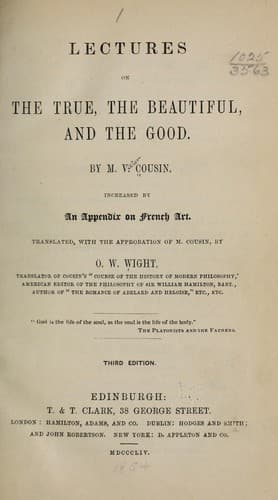
Lectures on the true, the beautiful and the goodCousin, Victor
Philosophy
Lectures on the true, the beautiful and the good
Cousin, Victor
Aesthetics; Ethics; Truth
The philosophy of the eighteenth century opens the second period of the
Cartesian era; it proposed to itself to apply the method already
discovered and too much neglected,--it applied itself to the analysis of
thought. Disabused of ambitious and sterile attempts, and, like
Descartes, disdainful of the past, the eighteenth century dared to think
that every thing in philosophy was to be done over again, and that, in
order not to wander anew, it was necessary to set out with the modest
study of man. Instead, therefore, of building up all at once systems
risked upon the universality of things, it undertook to examine what man
knows, what he can know; it brought back entire philosophy to the study
of our faculties, as physics had just been brought back to the study of
the properties of bodies,--which was giving to philosophy, if not its
end, at least its true beginning.
The great schools which divide the eighteenth century are the English
and French school, the Scotch school, and the German school, that is to
say, the school of Locke and Condillac, that of Reid, that of Kant. It
is impossible to misconceive the common principle which animates them,
the unity of their method. When one examines with impartiality the
method of Locke, he sees that it consists in the analysis of thought;
and it is thereby that Locke is a disciple, not of Bacon and Hobbes, but
of our great countryman, Descartes.[8] To study the human understanding
as it is in each one of us, to recognize its powers, and also its
limits, is the problem which the English philosopher proposed to
himself, and which he attempted to solve. I do not wish to judge here
of the solution which he gave of this problem; I limit myself to
indicating clearly what was for him the fundamental problem. Condillac,
the French disciple of Locke, made himself everywhere the apostle of
analysis; and analysis was also in him, or at least should have been,
the study of thought. No philosopher, not even Spinoza, has wandered
farther than Condillac[9] from the true experimental method, and has
strayed farther on the route of abstractions, even verbal abstractions;
but, strange enough, no one is severer than he against hypotheses, save
that of the statue-man. The author of the _Traite des Sensations_ has
very unfaithfully practised analysis; but he speaks of it without
cessation. The Scotch school combats Locke and Condillac; it combats
them, but with their own arms, with the same method which it pretends to
apply better.[10] In Germany, Kant wishes to replace in light and honor
the superior element of human consciousness, left in the shade, and
decried by the philosophy of his times; and for that end, what does he
do? He undertakes a profound examination of the faculty of knowing; the
title of his principal work is, _Critique of Pure Reason_;[11] it is a
critique, that is to say again, an analysis; the method of Kant is then
no other than that of Locke and Reid. Follow it until it reaches the
Public-domain text, read in full here on John Shaqi.
Reviews
Reviews
No reviews yet
Be the first to share your thoughts on this work.
Join the Discussion
Join the discussion
Sign in to leave a comment or review.
Sign InorCreate an account