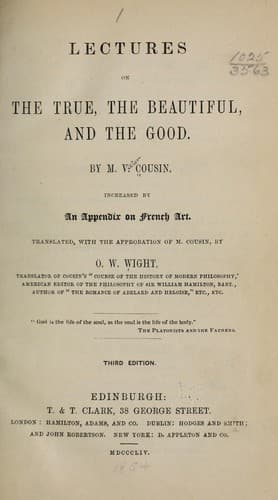
Lectures on the true, the beautiful and the goodCousin, Victor
Philosophy
Lectures on the true, the beautiful and the good
Cousin, Victor
Aesthetics; Ethics; Truth
hands of Fichte,[12] the successor of Kant, who died but a few years
since; there, again, the analysis of thought is given as the foundation
of philosophy. Kant was so firmly established in the subject of
knowledge, that he could scarcely go out of it--that, in fact, he never
did legitimately go out of it. Fichte plunged into the subject of
knowledge so deeply that he buried himself in it, and absorbed in the
human _me_ all existences, as well as all sciences--sad shipwreck of
analysis, which signalizes at once its greatest effort and its rock!
The same spirit, therefore, governs all the schools of the eighteenth
century; this century disdains arbitrary formulas; it has a horror for
hypotheses, and attaches itself, or pretends to attach itself, to the
observation of facts, and particularly to the analysis of thought.
Let us acknowledge with freedom and with grief, that the eighteenth
century applied analysis to all things without pity and without measure.
It cited before its tribunal all doctrines, all sciences; neither the
metaphysics of the preceding age, with their imposing systems, nor the
arts with their prestige, nor the governments with their ancient
authority, nor the religions with their majesty,--nothing found favor
before it. Although it spied abysses at the bottom of what it called
philosophy, it threw itself into them with a courage which is not
without grandeur; for the grandeur of man is to prefer what he believes
to be truth to himself. The eighteenth century let loose tempests.
Humanity no more progressed, except over ruins. The world was again
agitated in that state of disorder in which it had already been once
seen, at the decline of the ancient beliefs, and before the triumphs of
Christianity, when men wandered through all contraries, without power to
rest anywhere, given up to every disquietude of spirit, to every misery
of heart, fanatical and atheistical, mystical and incredulous,
voluptuous and sanguinary.[13] But if the philosophy of the eighteenth
century has left us a vacuity for an inheritance, it has also left us an
energetic and fecund love of truth. The eighteenth century was the age
of criticism and destructions; the nineteenth should be that of
intelligent rehabilitations. It belongs to it to find in a profounder
analysis of thought the principles of the future, and with so many
remains to raise, in fine, an edifice that reason may be able to
acknowledge.
Public-domain text, read in full here on John Shaqi.
Reviews
Reviews
No reviews yet
Be the first to share your thoughts on this work.
Join the Discussion
Join the discussion
Sign in to leave a comment or review.
Sign InorCreate an account