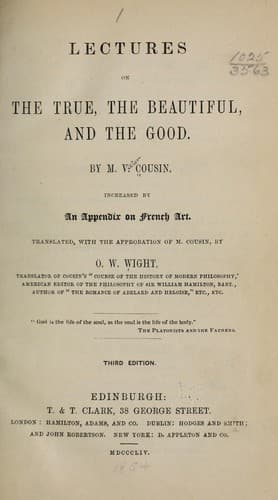
Lectures on the true, the beautiful and the goodCousin, Victor
Philosophy
Lectures on the true, the beautiful and the good
Cousin, Victor
Aesthetics; Ethics; Truth
A feeble but zealous workman, I come to bring my stone; I come to do my
work; I come to extract from the midst of the ruins what has not
perished, what cannot perish. This course is at once a return to the
past, an effort towards the future. I propose neither to attack nor to
defend any of the three great schools that divide the eighteenth
century. I will not attempt to perpetuate and envenom the warfare which
divides them, complacently designating the differences which separate
them, without taking an account of the community of method which unites
them. I come, on the contrary, a devoted soldier of philosophy, a common
friend of all the schools which it has produced, to offer to all the
words of peace.
The unity of modern philosophy, as we have said, resides in its method,
that is to say, in the analysis of thought--a method superior to its own
results, for it contains in itself the means of repairing the errors
that escape it, of indefinitely adding new riches to riches already
acquired. The physical sciences themselves have no other unity. The
great physicians who have appeared within two centuries, although united
amongst themselves by the same point of departure and by the same end,
generally accepted, have nevertheless proceeded with independence and in
ways often opposite. Time has re-collected in their different theories
the part of truth that produced them and sustained them; it has
neglected their errors from which they were unable to extricate
themselves, and uniting all the discoveries worthy of the name, it has
little by little formed of them a vast and harmonious whole. Modern
philosophy has also been enriched during the two centuries with a
multitude of exact observations, of solid and profound theories, for
which it is indebted to the common method. What has hindered her from
progressing at an equal pace with the physical sciences whose sister she
is? She has been hindered by not understanding better her own interests,
by not tolerating diversities that are inevitable, that are even
useful, and by not profiting by the truths which all the particular
doctrines contain, in order to deduce from them a general doctrine,
which is successively and perpetually purified and aggrandized.
Public-domain text, read in full here on John Shaqi.
Reviews
Reviews
No reviews yet
Be the first to share your thoughts on this work.
Join the Discussion
Join the discussion
Sign in to leave a comment or review.
Sign InorCreate an account