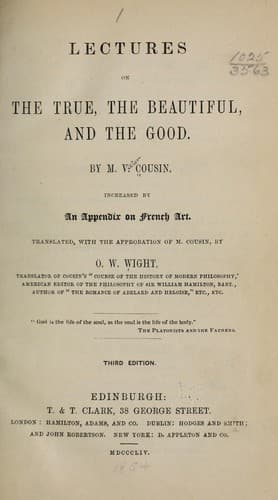
Lectures on the true, the beautiful and the goodCousin, Victor
Philosophy
Lectures on the true, the beautiful and the good
Cousin, Victor
Aesthetics; Ethics; Truth
Not, indeed, that I would recommend that blind syncretism which
destroyed the school of Alexandria, which attempted to bring contrary
systems together by force; what I recommend is an enlightened
eclecticism, which, judging with equity, and even with benevolence, all
schools, borrows from them what they possess of the true, and neglects
what in them is false. Since the spirit of party has hitherto succeeded
so ill with us, let us try the spirit of conciliation. Human thought is
immense. Each school has looked at it only from its own point of view.
This point of view is not false, but it is incomplete, and moreover, it
is exclusive. It expresses but one side of truth, and rejects all the
others. The question is not to decry and recommence the work of our
predecessors, but to perfect it in reuniting, and in fortifying by that
reunion, all the truths scattered in the different systems which the
eighteenth century has transmitted to us.
Such is the principle to which we have been conducted by two years of
study upon modern philosophy, from Descartes to our times. This
principle, badly disengaged at first, we applied for the first time
within the narrowest limits, and only to theories relative to the
question of personal existence.[14] We then extended it to a greater
number of questions and theories; we touched the principal points of the
intellectual and moral order,[15] and at the same time that we were
continuing the investigations of our illustrious predecessor, M.
Royer-Collard, upon the schools of France, England, and Scotland, we
commenced the study new among us, the difficult but interesting and
fecund study, of the philosophy of Koenigsberg. We can at the present
time, therefore, embrace all the schools of the eighteenth century, and
all the problems which they agitated.
Philosophy, in all times, turns upon the fundamental ideas of the true,
the beautiful, and the good. The idea of the true, philosophically
developed, is psychology, logic, metaphysic; the idea of the good is
private and public morals; the idea of the beautiful is that science
which, in Germany, is called aesthetics, the details of which pertain to
the criticism of literature, the criticism of arts, but whose general
principles have always occupied a more or less considerable place in the
researches, and even in the teaching of philosophers, from Plato and
Aristotle to Hutcheson and Kant.
Upon these essential points which constitute the entire domain of
philosophy, we will successively interrogate the principal schools of
the eighteenth century.
Public-domain text, read in full here on John Shaqi.
Reviews
Reviews
No reviews yet
Be the first to share your thoughts on this work.
Join the Discussion
Join the discussion
Sign in to leave a comment or review.
Sign InorCreate an account