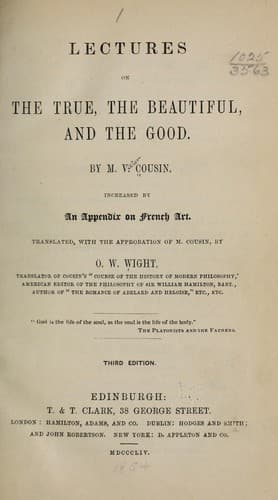
Lectures on the true, the beautiful and the goodCousin, Victor
Philosophy
Lectures on the true, the beautiful and the good
Cousin, Victor
Aesthetics; Ethics; Truth
What would logic become, those mathematics of thought, if you should
take away from it a certain number of principles, which are a little
barbarous, perhaps, in their scholastic form, but must be universal and
necessary in order to preside over all reasoning and every
demonstration?
Are physics possible, if every phenomenon which begins to appear does
not suppose a cause and a law?
Without the principle of final causes, could physiology proceed a single
step, render to itself an account of a single organ, or determine a
single function?
Is not the principle on which the whole of morals rests, the principle
which obligates man to good and lays the foundation of virtue, of the
same nature? Does it not extend to all moral beings, without distinction
of time and place? Can you conceive of a moral being who does not
recognize in the depth of his conscience that reason ought to govern
passion, that it is necessary to preserve sworn faith, and, against the
most pressing interest, to restore the treasure that has been confided
to us?
And these are not mere metaphysical prejudices and formulas of the
schools: I appeal to the most vulgar common sense.
If I should say to you that a murder has just been committed, could you
not ask me when, where, by whom, wherefore? That is to say, your mind is
directed by the universal and necessary principles of time, of space, of
cause, and even of final cause.
If I should say to you that love or ambition caused the murder, would
you not at the same instant conceive a lover, an ambitious person? This
means, again, that there is for you no act without an agent, no quality
and phenomenon without a substance, without a real subject.
If I should say to you that the accused pretends that he is not the same
person who conceived, willed, and executed this murder, and that, at
intervals, his personality has more than once been changed, would you
not say he is a fool if he is sincere, and that, although the acts and
the incidents have varied, the person and the being have remained the
same?
Suppose that the accused should defend himself on this ground, that the
murder must serve his interest; that, moreover, the person killed was so
unhappy that life was a burden to him; that the state loses nothing,
since in place of two worthless citizens it acquires one who becomes
useful to it; that, in fine, mankind will not perish by the loss of an
individual, &c.; to all these reasonings would you not oppose the very
simple response, that this murder, useful perhaps to its author, is not
the less unjust, and that, therefore, under no pretext was it permitted?
The same good sense which admits universal and necessary truths, easily
distinguishes them from those that are not universal and necessary, and
are only general, that is to say, are applied only to a greater or less
number of cases.
Public-domain text, read in full here on John Shaqi.
Reviews
Reviews
No reviews yet
Be the first to share your thoughts on this work.
Join the Discussion
Join the discussion
Sign in to leave a comment or review.
Sign InorCreate an account