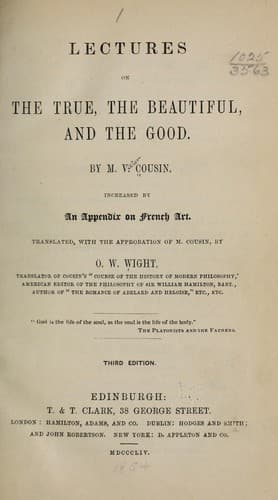
Lectures on the true, the beautiful and the good — John Shaqi
Lectures on the true, the beautiful and the goodCousin, Victor
Philosophy
Lectures on the true, the beautiful and the good
Cousin, Victor
Aesthetics; Ethics; Truth
For example, the following is a very general truth: the day succeeds the
night; but is it a universal and necessary truth? Does it extend to all
lands? Yes, to all known lands. But does it extend to all possible
lands? No; for it is possible to conceive of lands plunged in eternal
night, another system of the world being given. The laws of the material
world are what they are; they are not necessary. Their Author might have
chosen others. With another system of the world one conceives other
physics, but we cannot conceive other mathematics and other morals. Thus
it is possible to conceive that day and night may not be in the same
relation to each as that in which we see them; therefore the truth that
day succeeds night is a very general truth, perhaps even a universal
truth, but by no means a necessary truth.
Montesquieu has said that liberty is not a fruit of warm climates. I
acknowledge, if it is desired, that heat enervates the spirit, and that
warm countries maintain free governments with difficulty; but it does
not follow that there may be no possible exception to this principle:
moreover, there have been exceptions; hence it is not an absolutely
universal principle, much less is it a necessary principle. Could you
say as much of the principle of cause? Could you in any way conceive, in
any time and in any place, a phenomenon which begins to appear without
a cause, physical or moral?
And were it possible to reduce universal and necessary principles to
general principles, in order to employ and apply these principles thus
abased, and to found upon them any reasoning whatever, it would be
necessary to admit what is called in logic the principle of
contradiction, viz., that a thing cannot at the same time be and not be,
in order to maintain the integrity of each part of the reasoning; as
well as the principle of sufficient reason, which alone establishes
their connection and the legitimacy of the conclusion. Now, these two
principles, without which there is no reasoning, are themselves
universal and necessary principles; so that the circle is manifest.
Even were we to destroy in thought all existences, save that of a single
mind, we should be compelled to place in that mind, in order that it
might exercise itself at all--and the mind is such only on the condition
that it thinks--several necessary principles; it would be beyond the
power of thought to conceive it deprived of the principle of
contradiction and the principle of sufficient reason.
Public-domain text, read in full here on John Shaqi.
Reviews
Reviews
No reviews yet
Be the first to share your thoughts on this work.
Join the Discussion
Join the discussion
Sign in to leave a comment or review.
Sign InorCreate an account