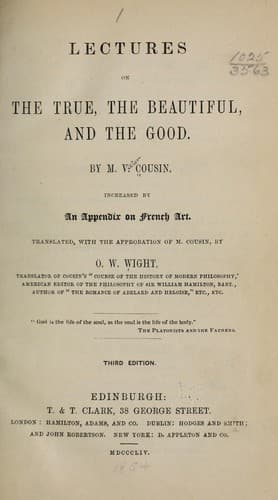
Lectures on the true, the beautiful and the goodCousin, Victor
Philosophy
Lectures on the true, the beautiful and the good
Cousin, Victor
Aesthetics; Ethics; Truth
How many times have we demonstrated the vanity of the efforts of the
empirical school to disturb the existence or weaken the bearing of
universal and necessary principles! Listen to this school: it will say
to you that the principle of cause, given by us as universal and
necessary, is, after all, only a habit of the mind, which, seeing in
nature a fact succeeding another fact, puts between these that
connection which we have called the relation of effect to cause. This
explanation is nothing but the destruction, not only of the principle of
causality, but even of the notion of cause. The senses show me two
balls, one of which begins to move, the other of which moves after it.
Suppose that this succession is renewed and continues; it will be
constancy added to succession; it will by no means be the connection of
a causative power with its effect; for example, that which consciousness
attests to us is the least effort of volition. Thus a consequent
empiricist, like Hume,[19] easily proves that no sensible experience
legitimately gives the idea of cause.
What we say of the notion of cause we might say of all notions of the
same kind. Let us at least instance those of substance and unity.
The senses perceive only qualities, phenomena. I touch the extension, I
see the color, I am sensible of the odor; but do our senses attain the
substance that is extended, colored, or odorous? On this point Hume[20]
indulges in pleasantries. He asks which one of our senses takes
cognizance of substance. What, then, according to him and in the system
of empiricism, is the notion of substance? An illusion like the notion
of cause.
Neither do the senses give us unity; for unity is identity, is
simplicity, and the senses show us every thing in succession and
composition. The works of art possess unity only because Art, that is to
say, the mind of man puts it there. If we perceive unity in the works of
nature, it is not the senses that discover it to us. The arrangement of
the different parts of an object may contain unity, but it is a unity of
organization, an ideal and moral unity which the mind alone conceives,
and which escapes the senses.
If the senses are not able to explain simple notions, much less still
are they able to explain the principles in which these notions are met,
which are universal and necessary. In fact, the senses clearly perceive
such and such facts, but it is impossible for them to embrace what is
universal; experience attests what is, it does not reach what cannot but
be.
We go farther. Not only is empiricism unable to explain universal and
necessary principles; but we maintain that, without these principles,
empiricism cannot even account for the knowledge of the sensible world.
Public-domain text, read in full here on John Shaqi.
Reviews
Reviews
No reviews yet
Be the first to share your thoughts on this work.
Join the Discussion
Join the discussion
Sign in to leave a comment or review.
Sign InorCreate an account