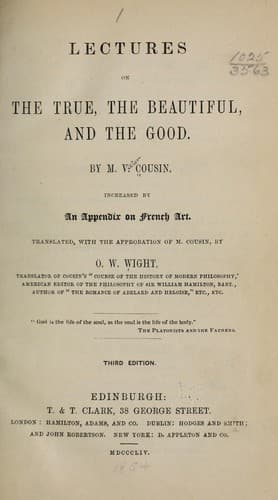
Lectures on the true, the beautiful and the good — John Shaqi
Lectures on the true, the beautiful and the goodCousin, Victor
Philosophy
Lectures on the true, the beautiful and the good
Cousin, Victor
Aesthetics; Ethics; Truth
Take away the principle of causality, and the human mind is condemned
never to go out of itself and its own modifications. All the sensations
of hearing, of smell, of taste, of touch, of feeling even, cannot inform
you what their cause is, nor whether they have a cause. But give to the
human mind the principle of causality, admit that every sensation, as
well as every phenomenon, every change, every event, has a cause, as
evidently we are not the cause of certain sensations, and that
especially these sensations must have a cause, and we are naturally led
to recognize for those sensations causes different from ourselves, and
that is the first notion of an exterior world. The universal and
necessary principle of causality alone gives it and justifies it. Other
principles of the same order increase and develop it.
As soon as you know that there are external objects, I ask you whether
you do not conceive them in a place that contains them. In order to deny
it, it would be necessary to deny that every body is in a place, that is
to say, to reject a truth of physics, which is at the same time a
principle of metaphysics, as well as an axiom of common sense. But the
place that contains a body is often itself a body, which is only more
capacious than the first. This new body is in its turn in a place. Is
this new place also a body? Then it is contained in another place more
extended, and so on; so that it is impossible for you to conceive a body
which is not in a place; and you arrive at the conception of a boundless
and infinite place, that contains all limited places and all possible
bodies: that boundless and infinite place is space.
And I tell you in this nothing that is not very simple. Look. Do you
deny that this water is in a vase? Do you deny that this vase is in this
hall? Do you deny that this hall is in a larger place, which is in its
turn in another larger still? I can thus carry you on to infinite space.
If you deny a single one of these propositions, you deny all, the first
as well as the last; and if you admit the first, you are forced to admit
the last.
It cannot be supposed that sensibility, which is not able to give us
even the idea of body, alone elevates us to the idea of space. The
intervention of a superior principle is, therefore, here necessary.
As we believe that every body is contained in a place, so we believe
that every event happens in time. Can you conceive an event happening,
except in some point of duration? This duration is extended and
successively increased to your mind's eye, and you end by conceiving it
unlimited like space. Deny duration, and you deny all the sciences that
measure it, you destroy all the natural beliefs upon which human life
reposes. It is hardly necessary to add that sensibility alone no more
explains the notion of time than that of space, both of which are
nevertheless inherent in the knowledge of the external world.
Public-domain text, read in full here on John Shaqi.
Reviews
Reviews
No reviews yet
Be the first to share your thoughts on this work.
Join the Discussion
Join the discussion
Sign in to leave a comment or review.
Sign InorCreate an account