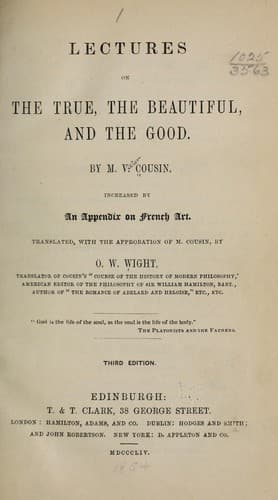
Lectures on the true, the beautiful and the goodCousin, Victor
Philosophy
Lectures on the true, the beautiful and the good
Cousin, Victor
Aesthetics; Ethics; Truth
Empiricism is, therefore, convicted of being unable to dispense with
universal and necessary principles, and of being unable to explain them.
Let us pause: either all our preceding works have terminated in nothing
but chimeras, or they permit us to consider as a point definitely
acquired for science, that there are in the human mind, for whomsoever
interrogates it sincerely, principles really stamped with the character
of universality and necessity.
After having established and defended the existence of universal and
necessary principles, we might investigate and pursue this kind of
principles in all the departments of human knowledge, and attempt an
exact and rigorous classification; but illustrious examples have taught
us to fear to compromise truths of the greatest price by mixing with
them conjectures which, in giving brilliancy, perhaps, to the spirit of
philosophy, diminish its authority in the eyes of the wise. We, also,
following the example of Kant, attempted before you, last year,[21] a
classification, even a reduction of universal and necessary principles,
and of all the notions that are connected with them. This work has not
lost for us its importance, but we will not reproduce it. In the
interest of the great cause which we serve, and taking thought here only
to establish upon solid foundations the doctrine which is adapted to the
French genius in the nineteenth century, we will carefully shun every
thing that might seem personal and hazardous; and, instead of examining,
criticising,[22] and reconstituting the classification which the
philosophy of Koenigsberg has given of universal and necessary
principles, we prefer, we find it much more useful, to enable you to
penetrate deeper into the nature of these principles, by showing you
what faculty of ours it is that discovers them to us, and to which they
are related and correspond.
The peculiarity of these principles is, that each one of us in
reflection recognizes that he possesses them, but that he is not their
author. We conceive them and apply them, we do not constitute them. Let
us interrogate our consciousness. Do we refer to ourselves, for example,
the definitions of geometry, as we do certain movements of which we feel
ourselves to be the cause? If it is I who make these definitions, they
are therefore mine, I can unmake them, modify them, change them, even
annihilate them. It is certain that I cannot do it. I am not, then, the
author of them. It has also been demonstrated that the principles of
which we have spoken cannot be derived from sensation, which is
variable, limited, incapable of producing and authorizing any thing
universal and necessary. I arrive, then, at the following consequence,
also necessary:--truth is in me and not by me. As sensibility puts me in
relation with the physical world, so another faculty puts me in
communication with the truths that depend upon neither the world nor me,
and that faculty is reason.
Public-domain text, read in full here on John Shaqi.
Reviews
Reviews
No reviews yet
Be the first to share your thoughts on this work.
Join the Discussion
Join the discussion
Sign in to leave a comment or review.
Sign InorCreate an account