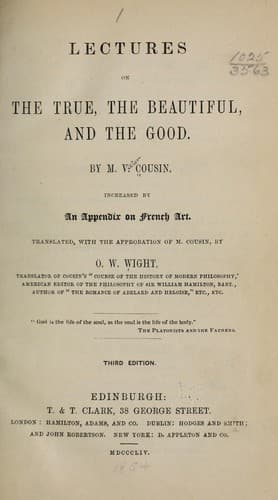
Lectures on the true, the beautiful and the good — John Shaqi
Lectures on the true, the beautiful and the goodCousin, Victor
Philosophy
Lectures on the true, the beautiful and the good
Cousin, Victor
Aesthetics; Ethics; Truth
There are in men three general faculties which are always mingled
together, and are rarely exercised except simultaneously, but which
analysis divides in order to study them better, without misconceiving
their reciprocal play, their intimate connection, their indivisible
unity. The first of these faculties is activity, voluntary and free
activity, in which human personality especially appears, and without
which the other faculties would be as if they were not, since we should
not exist for ourselves. Let us examine ourselves at the moment when a
sensation is produced in us; we shall recognize that there is
perception only so far as there is some degree of attention, and that
perception ends at the moment when our activity ends. One does not
recollect what he did in perfect sleep or in a swoon; because then he
had lost voluntary activity, consequently consciousness; consequently,
again, memory. Passion often, in depriving us of liberty, deprives us,
at the same time, of the consciousness of our actions and of ourselves;
then, to use a just and common expression, one knows not what he does.
It is by liberty that man is truly man, that he possesses himself and
governs himself; without it, he falls again under the yoke of nature; he
is, without it, only a more admirable and more beautiful part of nature.
But while I am endowed with activity and liberty, I am also passive in
other respects; I am subject to the laws of the external world; I suffer
and I enjoy without being myself the author of my joys and my
sufferings; I feel rising within me needs, desires, passions, which I
have not made, which by turns fill my life with happiness and misery.
Finally, besides volition and sensibility, man has the faculty of
knowing, has understanding, intelligence, reason, the name matters
little, by means of which he is elevated to truths of different orders,
and among others, to universal and necessary truths, which suppose in
reason, attached to its exercise, principles entirely distinct from the
impressions of the senses and the resolutions of the will.[23]
Voluntary activity, sensibility, reason, are all equally certain.
Consciousness verifies the existence of necessary principles, which
direct the reason quite as well as that of sensations and volitions. I
call every thing real that falls under observation. I suffer; my
suffering is real, inasmuch as I am conscious of it: it is the same with
liberty: it is the same with reason and the principles that govern it.
We can affirm, then, that the existence of universal and necessary
principles rests upon the testimony of observation, and even of the most
immediate and surest observation, that of consciousness.
Public-domain text, read in full here on John Shaqi.
Reviews
Reviews
No reviews yet
Be the first to share your thoughts on this work.
Join the Discussion
Join the discussion
Sign in to leave a comment or review.
Sign InorCreate an account