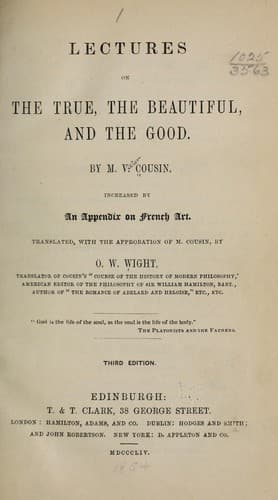
Lectures on the true, the beautiful and the good — John Shaqi
Lectures on the true, the beautiful and the goodCousin, Victor
Philosophy
Lectures on the true, the beautiful and the good
Cousin, Victor
Aesthetics; Ethics; Truth
But consciousness is only a witness,--it makes what is appear; it
creates nothing. It is not because consciousness announces it to you,
that you have produced such or such a movement, that you have
experienced such or such an impression. Neither is it because
consciousness says to us that reason is constrained to admit such or
such a truth, that this truth exists; it is because it exists that it is
impossible for reason not to admit it. The truths that reason attains by
the aid of universal and necessary principles with which it is provided,
are absolute truths; reason does not create them, it discovers them.
Reason is not the judge of its own principles, and cannot account for
them, for it only judges by them, and they are to it its own laws. Much
less does consciousness make these principles, or the truths which they
reveal to us; for consciousness has no other office, no other power than
in some sort to serve as a mirror for reason. Absolute truths are,
therefore, independent of experience and consciousness, and at the same
time, they are attested by experience and consciousness. On the one
hand, these truths declare themselves in experience; on the other, no
experience explains them. Behold how experience and reason differ and
agree, and how, by means of experience, we come to find something which
surpasses it.
So the philosophy which we teach rests neither upon hypothetical
principles, nor upon empirical principles. It is observation itself, but
observation applied to the higher portion of our knowledge, which
furnishes us with the principles that we seek, with a point of departure
at once solid and elevated.[24]
This point of departure we have found, and we do not abandon it. We
remain immovably attached to it. The study of universal and necessary
principles, considered under their different aspects, and in the great
problems which they solve, is almost the whole of philosophy; it fills
it, measures it, divides it. If psychology is the regular study of the
human mind and its laws, it is evident that that of universal and
necessary principles which preside over the exercise of reason, is the
especial domain of psychology, which in Germany is called rational
psychology, and is very different from empirical psychology. Since logic
is the examination of the value and the legitimacy of our different
means of knowing, its most important employment must be to estimate the
value and the legitimacy of the principles which are the foundations of
our most important cognitions. In fine, the meditation of these same
principles conducts us to theodicea, and opens to us the sanctuary of
philosophy, if we would ascend to their true source, to that sovereign
reason which is the first and last explanation of our own.
FOOTNOTES:
[18] 1st Series of our Course, vol. i.
[19] 1st Series, vol. i.
[20] Ibid.
[21] 1st Series, vol. i., Fragments of the Course of 1817.
[22] See that criticism, 1st Series, vol. v., _Kant_, lecture 8.
Public-domain text, read in full here on John Shaqi.
Reviews
Reviews
No reviews yet
Be the first to share your thoughts on this work.
Join the Discussion
Join the discussion
Sign in to leave a comment or review.
Sign InorCreate an account