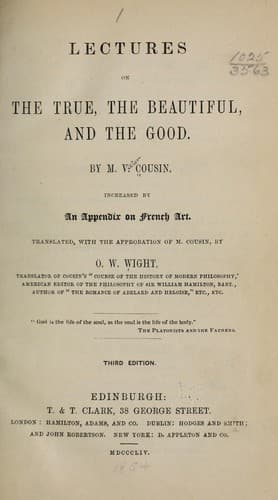
Lectures on the true, the beautiful and the goodCousin, Victor
Philosophy
Lectures on the true, the beautiful and the good
Cousin, Victor
Aesthetics; Ethics; Truth
[23] This classification of the human faculties, save some differences
more nominal than real, is now generally adopted, and makes the
foundation of the psychology of our times. See our writings, among
others, 1st Series, Course of 1816, lectures 23 and 24: _Histoire du
moi_; ibid., _Des faits de Conscience_; vol. iii., lecture 3, _Examen de
la Theorie des Facultes dans Condillac_; vol. iv., lecture 21, _des
Facultes selon Reid_; vol. v., lecture 8, _Examen de la Theorie de
Kant_; 3d Series, vol iv., _Preface de la Premiere Edition, Examen des
Lecons de M. Laromiguiere, Introduction aux Oeuvres de M. de Biran,
etc._
[24] This lecture on the existence of universal and necessary
principles, which was easily comprehended, in 1818, by an auditory to
which long discussions had already been presented during the two
previous years, appearing here without the support of these
preliminaries, will not perhaps be entirely satisfactory to the reader.
We beseech him to consult carefully the first volume of the 1st Series
of our Course, which contains an abridgment, at least, of the numerous
lectures of 1816 and 1817, of which this is a _resume_; especially to
read in the third, fourth, and fifth volumes of the 1st Series, the
developed analyses, in which, under different forms, universal and
necessary principles are demonstrated as far as may be, and in the third
volume of the 2d Series the lectures devoted to establish against Locke
the same principles.
LECTURE II.
ORIGIN OF UNIVERSAL AND NECESSARY PRINCIPLES.
_Resume_ of the preceding Lecture. A new question, that of the
origin of universal and necessary principles.--Danger of this
question, and its necessity.--Different forms under which truth
presents itself to us, and the successive order of these forms:
theory of spontaneity and reflection.--The primitive form of
principles; abstraction that disengages them from that form, and
gives them their actual form.--Examination and refutation of the
theory that attempts to explain the origin of principles by an
induction founded on particular notions.
We may regard as a certain conquest of the experimental method and of
true psychological analysis, the establishment of principles which at
the same time that they are given to us by the surest of all
experiences, that of consciousness, have a bearing superior to
experience, and open to us regions inaccessible to empiricism. We have
recognized such principles at the head of nearly all the sciences; then,
searching among our different faculties for that which may have given
them to us, we have ascertained that it is impossible to refer them to
any other faculty than to that general faculty of knowing which we call
reason, very different from reasoning, to which it furnishes its laws.
That is the point at which we have arrived. But is it possible to stop
there?
Public-domain text, read in full here on John Shaqi.
Reviews
Reviews
No reviews yet
Be the first to share your thoughts on this work.
Join the Discussion
Join the discussion
Sign in to leave a comment or review.
Sign InorCreate an account