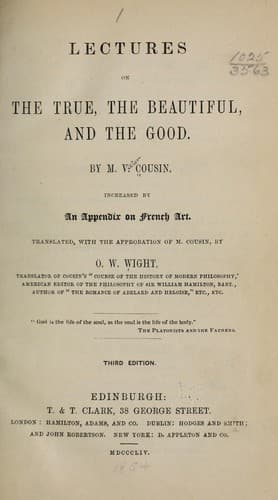
Lectures on the true, the beautiful and the goodCousin, Victor
Philosophy
Lectures on the true, the beautiful and the good
Cousin, Victor
Aesthetics; Ethics; Truth
In human intelligence, as it is now developed, universal and necessary
principles are offered to us under forms in some sort consecrated. The
principle of causality, for example, is thus enounced to us:--Every
thing that begins to appear necessarily has a cause. Other principles
have this same axiomatic form. But have they always had it, and did they
spring from the human mind with this logical and scholastic apparel, as
Minerva sprang all armed from the head of Jupiter? With what characters
did they show themselves at first, before taking those in which they are
now clothed, and which can scarcely be their primitive characters? In a
word, is it possible to find the origin of universal and necessary
principles, and the route which they must have followed in order to
arrive at what they are to-day? A new problem, the importance of which
it is easy to feel; for, if it can be resolved, what light will be shed
upon these principles! On the other hand, what difficulties must be
encountered! How can we penetrate to the sources of human knowledge,
which are concealed, like those of the Nile? Is it not to be feared
that, in plunging into the obscure past, instead of truth, one may
encounter an hypothesis; that, attaching himself, then, to this
hypothesis, he may transport it from the past to the present, and that,
being deceived in regard to the origin of principles, he may be led to
misconceive their actual and certain characters, or, at least, to
mutilate and enfeeble those which the adopted origin would not easily
explain? This danger is so great, this rock is so celebrated in
shipwrecks, that before braving it one should know how to take many
precautions against the seductions of the spirit of the system. It is
even conceived that great philosophers, who were timid in no place, have
suppressed the perilous problem. In fact, by undertaking to grapple with
this problem at first, Locke and Condillac went far astray,[25] and it
must be said, corrupted all philosophy at its source. The empirical
school, which lauds the experimental method so much, turns its back upon
it, thus to speak, when, instead of commencing by the study of the
actual characters of our cognitions, as they are attested to us by
consciousness and reflection, it plunges, without light and without
guidance, into the pursuit of their origin. Reid[26] and Kant[27] showed
themselves much more observing by confining themselves within the
limits of the present, through fear of losing themselves in the darkness
of the past. Both freely treat of universal and necessary principles in
the form which they now have, without asking what was their primitive
form. We much prefer this wise circumspection to the adventurous spirit
of the empirical school. Nevertheless, when a problem is given out, so
long as it is not solved, it troubles and besets the human mind.
Philosophy ought not to shun it then, but its duty is to approach it
only with extreme prudence and a severe method.
Public-domain text, read in full here on John Shaqi.
Reviews
Reviews
No reviews yet
Be the first to share your thoughts on this work.
Join the Discussion
Join the discussion
Sign in to leave a comment or review.
Sign InorCreate an account