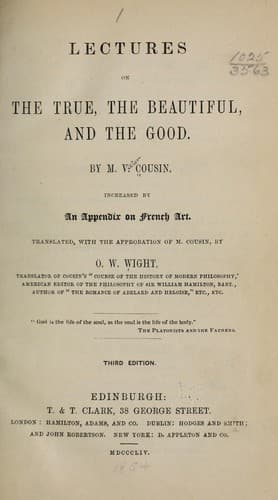
Lectures on the true, the beautiful and the goodCousin, Victor
Philosophy
Lectures on the true, the beautiful and the good
Cousin, Victor
Aesthetics; Ethics; Truth
We cannot recollect too well, for the sake of others and ourselves, that
the primitive state of human cognitions is remote from us; we can
scarcely bring it within the reach of our vision and submit it to
observation; the actual state, on the contrary, is always at our
disposal: it is sufficient for us to enter into ourselves, to fathom
consciousness by reflection, and make it give up what it contains.
Setting out from certain facts, we shall not be liable to wander
subsequently into hypotheses, or if, in ascending to the primitive
state, we fall into any error, we shall be able to perceive it and
repair it by the aid of the truth which an impartial observation shall
have given us; every origin which shall not legitimately end at the
point where we are, is by that alone convicted of being false, and will
deserve to be discarded.[28]
You know that a large portion of the last year was spent upon this
question. We took, one by one, universal and necessary questions
submitted to our examination, in order to determine the origin of each
one of them, its primitive form, and the different forms which have
successively clothed it; only after having operated thus upon a
sufficiently large number of principles, did we come slowly to a general
conclusion, and that conclusion we believe ourselves entitled to express
here briefly as the solid result of a most circumspect analysis, and, at
least, a most methodical labor. We must either renew before you this
labor, this analysis, and thereby run the risk of not being able to
complete the long course that we have marked out for ourselves, or we
must limit ourselves to reminding you of the essential traits of the
theory at which we arrived.
This theory, moreover, is in itself so simple, that, without the dress
of regular demonstrations upon which it is founded, its own evidence
will sufficiently establish it. It wholly rests upon the distinction
between the different forms under which truth is presented to us. It is,
in its somewhat arid generality, as follows:
1st. One can perceive truth in two different ways. Sometimes one
perceives it in such or such a particular circumstance. For example, in
presence of two apples or two stones, and of two other similar objects
placed by the side of the first, I perceive this truth with absolute
certainty, viz., that these two stones and these two other stones make
four stones,--which is in some sort a concrete apperception of the
truth, because the truth is given to us in regard to real and
determinate objects. Sometimes I also affirm in a general manner that
two and two equal four, abstracting every determinate object,--which is
the abstract conception of truth.
Public-domain text, read in full here on John Shaqi.
Reviews
Reviews
No reviews yet
Be the first to share your thoughts on this work.
Join the Discussion
Join the discussion
Sign in to leave a comment or review.
Sign InorCreate an account