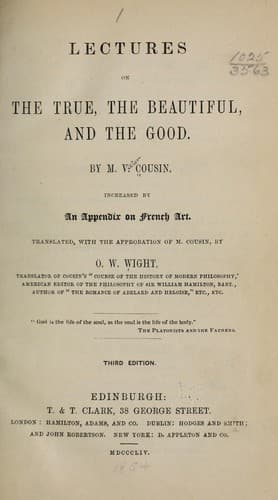
Lectures on the true, the beautiful and the goodCousin, Victor
Philosophy
Lectures on the true, the beautiful and the good
Cousin, Victor
Aesthetics; Ethics; Truth
Now, of these two ways of knowing truth, which precedes in the
chronological order of human knowledge? Is it not certain, may it not be
avowed by every one, that the particular precedes the general, that the
concrete precedes the abstract, that we begin by perceiving such or such
a determinate truth, in such or such a case, at such or such a moment,
in such or such a place, before conceiving a general truth,
independently of every application and different circumstances of place
and time?
2d. We can perceive the same truth without asking ourselves this
question: Have we the ability not to admit this truth? We perceive it,
then, by virtue alone of the intelligence which has been given us, and
which enters spontaneously into exercise; or rather, we try to doubt the
truth which we perceive, we attempt to deny it; we are not able to do
it, and then it is presented to reflection as superior to all possible
negation; it appears to us no longer only as a truth, but as a necessary
truth.
Is it not also evident, that we do not begin by reflection, that
reflection supposes an anterior operation, and that this operation, in
order not to be one of reflection, and not to suppose another before it,
must be entirely spontaneous; that thus the spontaneous and instinctive
intuition of truth precedes its reflection and necessary conception?
Reflection is a progress more or less tardy in the individual and in the
race. It is, _par excellence_, the philosophic faculty; it sometimes
engenders doubt and skepticism, sometimes convictions that, for being
rational, are only the more profound. It constructs systems, it creates
artificial logic, and all those formulas which we now use by the force
of habit as if they were natural to us. But spontaneous intuition is the
true logic of nature. It presides over the acquisition of nearly all our
cognitions. Children, the people, three-fourths of the human race never
pass beyond it, and rest there with boundless security.
The question of the origin of human cognitions is thus resolved for us
in the simplest manner: it is enough for us to determine that operation
of the mind which precedes all others, without which no other would take
place, and which is the first exercise, and the first form of our
faculty of knowing.[29]
Public-domain text, read in full here on John Shaqi.
Reviews
Reviews
No reviews yet
Be the first to share your thoughts on this work.
Join the Discussion
Join the discussion
Sign in to leave a comment or review.
Sign InorCreate an account