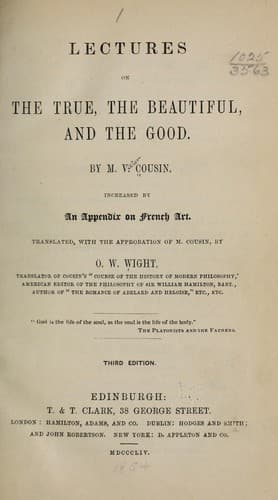
Lectures on the true, the beautiful and the goodCousin, Victor
Philosophy
Lectures on the true, the beautiful and the good
Cousin, Victor
Aesthetics; Ethics; Truth
Since every thing that bears the character of reflection cannot be
primitive, and supposes an anterior state, it follows, that the
principles which are the subject of our study could not have possessed
at first the reflective and abstract character with which they are now
marked, that they must have shown themselves at their origin in some
particular circumstance, under a concrete and determinate form, and that
in time they were disengaged from this form, in order to be invested
with their actual, abstract, and universal form. These are the two ends
of the chain; it remains for us to seek how the human mind has been from
one to the other, from the primitive state to the actual state, from the
concrete state to the abstract state.
How can we go from the concrete to the abstract? Evidently by that
well-known operation which is called abstraction. Thus far, nothing is
more simple. But it is necessary to discriminate between two sorts of
abstractions.
In presence of several particular objects, you omit the characters which
distinguish them, and separately consider a character which is common to
them all--you abstract this character. Examine the nature and conditions
of this abstraction; it proceeds by means of comparison, and it is
founded on a certain number of particular and different cases. Take an
example: examine how we form the abstract and general idea of color.
Place before my eyes for the first time a white object. Can I here at
the first step immediately arrive at a general idea of color? Can I at
first place on one side the whiteness, and on the other side the color?
Analyze what passes within you. You experience a sensation of whiteness.
Omit the individuality of this sensation, and you wholly destroy it; you
cannot neglect the whiteness, and preserve or abstract the color; for, a
single color being given, which is a white color, if you take away
that, there remains to you absolutely nothing in regard to color. Let a
blue object succeed this white object, then a red object, etc.; having
sensations differing from each other, you can neglect their differences,
and only consider what they have in common, that they are sensations of
sight, that is to say, colors, and you thus obtain the abstract and
general idea of color. Take another example: if you had never smelled
but a single flower, the violet, for instance, would you have had the
idea of odor in general? No. The odor of the violet would be for you the
only odor, beyond which you would not seek, you could not even imagine
another. But if to the odor of the violet is added that of the rose, and
other different odors, in a greater or less number, provided there be
several, and a comparison be possible, and consequently, knowledge of
their differences and their resemblances, then you will be able to form
the general idea of odor. What is there in common between the odor of
one flower and that of another flower, except that they have been
Public-domain text, read in full here on John Shaqi.
Reviews
Reviews
No reviews yet
Be the first to share your thoughts on this work.
Join the Discussion
Join the discussion
Sign in to leave a comment or review.
Sign InorCreate an account