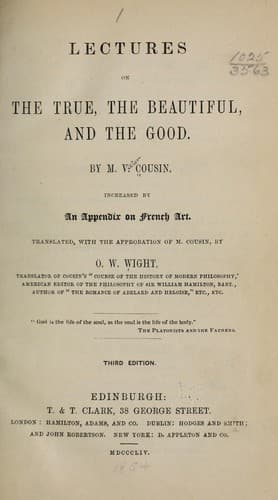
Lectures on the true, the beautiful and the goodCousin, Victor
Philosophy
Lectures on the true, the beautiful and the good
Cousin, Victor
Aesthetics; Ethics; Truth
smelled by aid of the same organ, and by the same person? What here
renders generalization possible, is the unity of the sentient subject
which remembers having been modified, while remaining the same, by
different sensations; now, this subject can feel itself identical under
different modifications, and it can conceive in the qualities of the
object felt some resemblance and some dissimilarity, only on the
condition of a certain number of sensations experienced, of odors
smelled. In that case, but in that case alone, there can be comparison,
abstraction, and generalization, because there are different and similar
elements.
In order to arrive at the abstract form of universal and necessary
principles, we have no need of all this labor. Let us take again, for
example, the principle of cause. If you suppose six particular cases
from which you have abstracted this principle, it will contain neither
more nor less ideas than if you had deduced it from a single one. To be
able to say that the event which I see must have a cause, it is not
indispensable to have seen several events succeed each other. The
principle which compels me to pronounce this judgment, is already
complete in the first as in the last event; it can change in respect to
its object, it cannot change in itself; it neither increases nor
decreases with the greater or less number of its applications. The only
difference that it is subject to in regard to us, is, that we apply it
whether we remark it or not, whether we disengage it or not from its
particular application. The question is not to eliminate the
particularity of the phenomenon, wherein it appears to us, whether it be
the fall of a leaf or the murder of a man, in order immediately to
conceive, in a general and abstract manner, the necessity of a cause for
every thing that begins to exist. Here, it is not because I have been
the same, or have been affected in the same manner in several different
cases, that I have come to this general and abstract conception. A leaf
falls: at the same instant I think, I believe, I declare that this
falling of the leaf must have a cause. A man has been killed: at the
same instant I believe, I proclaim that this death must have a cause.
Each one of these facts contains particular and variable circumstances,
and something universal and necessary, to wit, both of them cannot but
have a cause. Now, I am perfectly able to disengage the universal from
the particular, in regard to the first fact as well as in regard to the
second fact, for the universal is in the first quite as well as in the
second. In fact, if the principle of causality is not universal in the
first fact, neither will it be in the second, nor in the third, nor in a
thousandth; for a thousand are not nearer than one to the infinite, to
absolute universality. It is the same, and still more evidently, with
necessity. Pay particular attention to this point: if necessity is not
Public-domain text, read in full here on John Shaqi.
Reviews
Reviews
No reviews yet
Be the first to share your thoughts on this work.
Join the Discussion
Join the discussion
Sign in to leave a comment or review.
Sign InorCreate an account