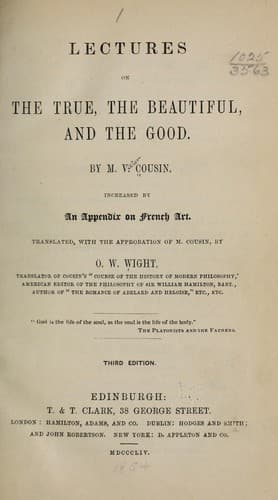
Lectures on the true, the beautiful and the goodCousin, Victor
Philosophy
Lectures on the true, the beautiful and the good
Cousin, Victor
Aesthetics; Ethics; Truth
in the first fact, it cannot be in any; for necessity cannot be formed
little by little, and by successive increment. If, at the first murder
that I see, I do not exclaim that this murder necessarily has a cause,
at the thousandth murder, although it shall have been proved that all
the others have had causes, I shall have the right to think that this
new murder has, very probably, also its cause; but I shall never have
the right to declare that it necessarily has a cause. But when
necessity and universality are already in a single case, that case alone
is sufficient to entitle us to deduce them from it.[30]
We have established the existence of universal and necessary principles:
we have marked their origin; we have shown that they appear to us at
first from a particular fact, and we have shown by what process, by what
sort of abstraction the mind disengages them from the determinate and
concrete form which envelops them, but does not constitute them. Our
task, then, seems accomplished. But it is not,--we must defend the
solution which we have just presented to you of the problem of the
origin of principles against the theory of an eminent metaphysician,
whose just authority might seduce you. M. Maine de Biran[31] is, like
us, the declared adversary of the philosophy of sensation,--he admits
universal and necessary principles; but the origin which he assigns to
them, puts them, according to us, in peril, and would lead back by a
_detour_ to the empirical school.
Universal and necessary principles, if expressed in propositions,
embrace several terms. For example, in the principle that every
phenomenon supposes a cause; and in this, that every quality supposes a
substance, by the side of the ideas of quality and phenomenon are met
the ideas of cause and substance, which seem the foundation of these two
principles. M. de Biran pretends that the two ideas are anterior to the
two principles which contain them, and that we at first find these ideas
in ourselves in the consciousness that we are cause and substance, and
that, these ideas once being thus acquired, induction transports them
out of ourselves, makes us conceive causes and substances wherever there
are phenomena and qualities, and that the principles of cause and
substance are thus explained. I beg pardon of my illustrious friend;
but it is impossible to admit in the least degree this explanation.
The possession of the origin of the idea of cause is by no means
sufficient for the possession of the origin of the principle of
causality; for the idea and the principle are things essentially
different. You have established, I would say to M. de Biran, that the
idea of cause is found in that of productive volition:--you will to
produce certain effects, and you produce them; hence the idea of a
cause, of a particular cause, which is yourself; but between this fact
and the axiom that all phenomena which appear necessarily have a cause,
there is a gulf.
Public-domain text, read in full here on John Shaqi.
Reviews
Reviews
No reviews yet
Be the first to share your thoughts on this work.
Join the Discussion
Join the discussion
Sign in to leave a comment or review.
Sign InorCreate an account