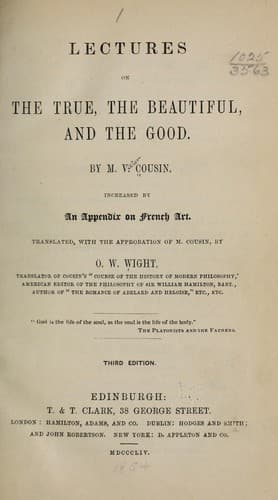
Lectures on the true, the beautiful and the goodCousin, Victor
Philosophy
Lectures on the true, the beautiful and the good
Cousin, Victor
Aesthetics; Ethics; Truth
You believe that you can bridge it over by induction. The idea of cause
once found in ourselves, induction applies it, you say, wherever a new
phenomenon appears. But let us not be deceived by words, and let us
account for this extraordinary induction. The following dilemma I submit
with confidence to the loyal dialectics of M. de Biran:
Is the induction of which you speak universal and necessary? Then it is
a different name for the same thing. An induction which forces us
universally and necessarily to associate the idea of cause with that of
every phenomenon that begins to appear is precisely what is called the
principle of causality. On the contrary, is this induction neither
universal nor necessary? It cannot supply the place of the principle of
cause, and the explanation destroys the thing to be explained.
It follows from this that the only true result of these various
psychological investigations is, that the idea of personal and free
cause precedes all exercise of the principle of causality, but without
explaining it.
The theory which we combat is much more powerless in regard to other
principles which, far from being exercised before the ideas from which
it is pretended to deduce them, precede them, and even give birth to
them. How have we acquired the idea of time and that of space, except by
aid of the principle that the bodies and events, which we see are in
time and in space? We have seen[32] that, without this principle, and
confined to the data of the senses and consciousness, neither time nor
space would exist for us. Whence have we deduced the idea of the
infinite, except from the principle that the finite supposes the
infinite, that all finite and defective things, which we perceive by our
senses and feel within us, are not sufficient for themselves, and
suppose something infinite and perfect? Omit the principle, and the idea
of the infinite is destroyed. Evidently this idea is derived from the
application of the principle, and it is not the principle which is
derived from the idea.
Public-domain text, read in full here on John Shaqi.
Reviews
Reviews
No reviews yet
Be the first to share your thoughts on this work.
Join the Discussion
Join the discussion
Sign in to leave a comment or review.
Sign InorCreate an account