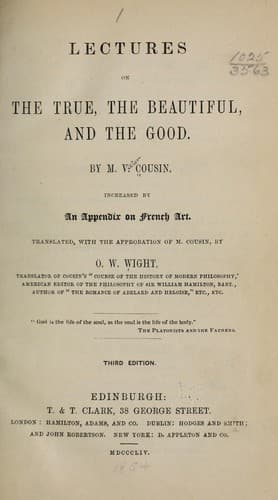
Lectures on the true, the beautiful and the goodCousin, Victor
Philosophy
Lectures on the true, the beautiful and the good
Cousin, Victor
Aesthetics; Ethics; Truth
Let us dwell a little longer on the principle of substances. The
question is to know whether the idea of subject, of substance, precedes
or follows the exercise of the principle. Upon what ground could the
idea of substance be anterior to the principle that every quality
supposes a substance? Upon the ground alone that substance be the object
of self-observation, as cause is said to be. When I produce a certain
effect, I may perceive myself in action and as cause; in that case,
there would be no need of the intervention of any principle; but it is
not, it cannot be, the same, when the question is concerning the
substance which is the basis of the phenomena of consciousness, of our
qualities, our acts, our faculties even; for this substance is not
directly observable; it does not perceive itself, it conceives itself.
Consciousness perceives sensation, volition, thought, it does not
perceive their subject. Who has ever perceived the soul? Has it not been
necessary, in order to attain this invisible essence, to set out from a
principle which has the power to bind the visible to the invisible,
phenomenon to being, to wit, the principle of substances?[33] The idea
of substance is necessarily posterior to the application of the
principle, and, consequently, it cannot explain its formation.
Let us be well understood. We do not mean to say that we have in the
mind the principle of substances before perceiving a phenomenon, quite
ready to apply the principle to the phenomenon, when it shall present
itself; we only say that it is impossible for us to perceive a
phenomenon without conceiving at the same instant a substance, that is
to say, to the power of perceiving a phenomenon, either by the senses or
by consciousness, is joined that of conceiving the substance in which it
inheres. The facts thus take place:--the perception of phenomena and the
conception of the substance which is their basis are not successive,
they are simultaneous. Before this impartial analysis fall at once two
equal and opposite errors--one, that experience, exterior or interior,
can beget principles; the other, that principles precede experience.[34]
To sum up, the pretension of explaining principles by the ideas which
they contain, is a chimerical one. In supposing that all the ideas which
enter into principles are anterior to them, it is necessary to show how
principles are deduced from these ideas,--which is the first and radical
difficulty. Moreover, it is not true that in all cases ideas precede
principles, for often principles precede ideas,--a second difficulty
equally insurmountable. But whether ideas are anterior or posterior to
principles, principles are always independent of them; they surpass them
by all the superiority of universal and necessary principles over simple
ideas.[35]
Public-domain text, read in full here on John Shaqi.
Reviews
Reviews
No reviews yet
Be the first to share your thoughts on this work.
Join the Discussion
Join the discussion
Sign in to leave a comment or review.
Sign InorCreate an account