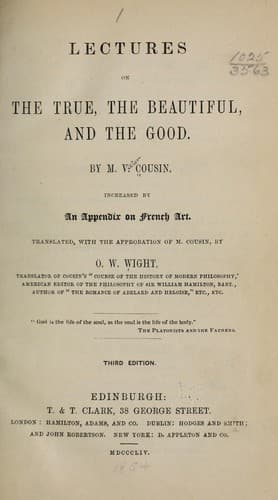
Lectures on the true, the beautiful and the good — John Shaqi
Lectures on the true, the beautiful and the goodCousin, Victor
Philosophy
Lectures on the true, the beautiful and the good
Cousin, Victor
Aesthetics; Ethics; Truth
We should, perhaps, beg your pardon for the austerity of this lecture.
But philosophical questions must be treated philosophically: it does not
belong to us to change their character. On other subjects, another
language. Psychology has its own language, the entire merit of which is
a severe precision, as the highest law of psychology itself is the
shunning of every hypothesis, and an inviolable respect for facts. This
law we have religiously followed. While investigating the origin of
universal and necessary principles, we have especially endeavored not to
destroy the thing to be explained by a systematic explanation. Universal
and necessary principles have come forth in their integrity from our
analysis. We have given the history of the different forms which they
successively assume, and we have shown, that in all these changes they
remain the same, and of the same authority, whether they enter
spontaneously and involuntarily into exercise, and apply themselves to
particular and determinate objects, or reflection turns them back upon
themselves in order to interrogate them in regard to their nature, or
abstraction makes them appear under the form in which their universality
and their necessity are manifest. Their certainty is the same under all
their forms, in all their applications; it has neither generation nor
origin; it is not born such or such a day, and it does not increase with
time, for it knows no degrees. We have not commenced by believing a
little in the principle of causality, of substances, of time, of space,
of the infinite, etc., then believing a little more, then believing
wholly. These principles have been, from the beginning, what they will
be in the end, all-powerful, necessary, irresistible. The conviction
which they give is always absolute, only it is not always accompanied by
a clear consciousness. Leibnitz himself has no more confidence in the
principle of causality, and even in his favorite principle of sufficient
reason, than the most ignorant of men; but the latter applies these
principles without reflecting on their power, by which he is
unconsciously governed, whilst Leibnitz is astonished at their power,
studies it, and for all explanation, refers it to the human mind, and to
the nature of things, that is to say, he elevates, to borrow the fine
expression of M. Royer-Collard,[36] the ignorance of the mass of men to
its highest source. Such is, thank heaven, the only difference that
separates the peasant from the philosopher, in regard to those great
principles of every kind which, in one way or another, discover to men
the same truths indispensable to their physical, intellectual, and moral
existence, and, in their ephemeral life, on the circumscribed point of
space and time where fortune has thrown them, reveal to them something
of the universal, the necessary, and the infinite.
FOOTNOTES:
[25] First Series, vol. iv., lectures 1, 2, and 3.
[26] _Ibid._, vol. iv., etc.
[27] _Ibid._, vol. v., lecture 8.
Public-domain text, read in full here on John Shaqi.
Reviews
Reviews
No reviews yet
Be the first to share your thoughts on this work.
Join the Discussion
Join the discussion
Sign in to leave a comment or review.
Sign InorCreate an account