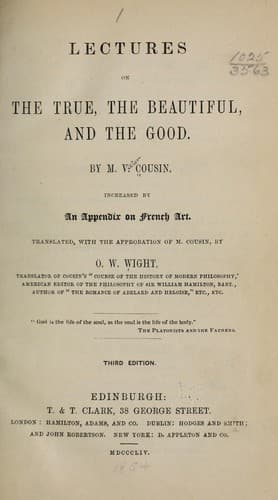
Lectures on the true, the beautiful and the goodCousin, Victor
Philosophy
Lectures on the true, the beautiful and the good
Cousin, Victor
Aesthetics; Ethics; Truth
[28] We have everywhere called to mind, maintained, and confirmed by the
errors of those who have dared to break it, this rule of true
psychological analysis, that, before passing to the question of the
origin of an idea, a notion, a belief, any principle whatever, the
actual characters of this idea, this notion, this belief, this
principle, must have been a long time studied and well established, with
the firm resolution of not altering them under any pretext whatever in
wishing to explain them. We believe that we have, as Leibnitz says,
settled this point. See 1st Series, vol. i., Programme of the Course of
1817, and the Opening Discourse; vol. iii., lecture 1, _Locke_; lecture
2, _Condillac_; lecture 3, almost entire, and lecture 8, p. 260; 2d
Series, vol. iii., _Examen du Systeme de Locke_, lecture 16, p. 77-87;
3d Series, vol. iv., _Examination of the Lectures of M. Loremquiere_, p.
268.
[29] This theory of spontaneity and of reflection, which in our view is
the key to so many difficulties, continually recurs in our works. One
may see, vol. i. of the 1st Series, in a programme of the Course of
1817, and in a fragment entitled _De la Spontaneite et de la Reflexion_;
vol. iv. of the same Series, Examination of Reid's Philosophy, _passim_;
vol. v., Examination of Kant's System, lecture 8; 2d Series, vol. i.,
_passim_; vol. iii., Lectures on Judgment; 3d Series, _Fragments
Philosophiques_, vol. iv., preface of the first edition, p. 37, etc.; it
will be found in different lectures of this volume, among others, in the
third, On the value of Universal and Necessary Principles; in the fifth,
On Mysticism; and in the eleventh, Primary Data of Common Sense.
[30] On immediate abstraction and comparative abstraction, see 1st
Series, vol. i., Programme of the Course of 1817, and everywhere in our
other Courses.
[31] On M. de Biran, on his merits and defects, see our _Introduction_
at the head of his Works.
[32] See lecture 1.
[33] See vol. i. of the 1st Series, course of 1816, and 2d Series, vol.
iii., lecture 18, p. 140-146.
[34] We have developed this analysis, and elucidated these results in
the 17th lecture of vol. ii. of the 2d Series.
Public-domain text, read in full here on John Shaqi.
Reviews
Reviews
No reviews yet
Be the first to share your thoughts on this work.
Join the Discussion
Join the discussion
Sign in to leave a comment or review.
Sign InorCreate an account