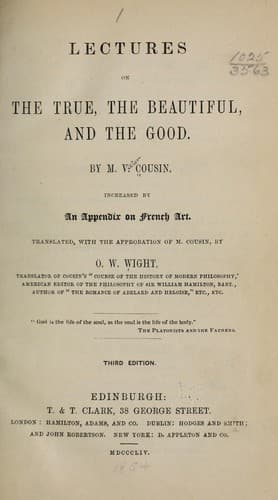
Lectures on the true, the beautiful and the goodCousin, Victor
Philosophy
Lectures on the true, the beautiful and the good
Cousin, Victor
Aesthetics; Ethics; Truth
[35] We have already twice recurred, and more in detail, to the
impossibility of legitimately explaining universal and necessary
principles by any association or induction whatever, founded upon any
particular idea, 2d Series, vol. iii., _Examen du Systeme de Locke_,
lecture 19, p. 166; and 3d Series, vol. iv., _Introduction aux Oeuvres
de M. de Biran_, p. 319. We have also made known the opinion of Reid,
1st Series, vol. iv., lecture 22, p. 489. Finally, the profoundest of
Reid's disciples, the most enlightened judge that we know of things
philosophical, Sir W. Hamilton, professor of logic in the University of
Edinburgh, has not hesitated to adopt the conclusions of our discussion,
to which he is pleased to refer his readers:--_Discussions on Philosophy
and Literature, etc._, by Sir William Hamilton, London, 1852. Appendix
I, p. 588.
[36] _Oeuvres de Reid_, vol. iv., p. 435. "When we revolt against
primitive facts, we equally misconceive the constitution of our
intelligence and the end of philosophy. Is explaining a fact any thing
else than deriving it from another fact, and if this kind of explanation
is to terminate at all, does it not suppose facts inexplicable? The
science of the human mind will have been carried to the highest degree
of perfection it can attain, it will be complete, when it shall know how
to derive ignorance from the most elevated source."
LECTURE III.
ON THE VALUE OF UNIVERSAL AND NECESSARY PRINCIPLES.
Examination and refutation of Kant's skepticism.--Recurrence to
the theory of spontaneity and reflection.
After having recognized the existence of universal and necessary
principles, their actual characters, and their primitive characters, we
have to examine their value, and the legitimacy of the conclusions which
may be drawn from them,--we pass from psychology to logic.
We have defended against Locke and his school the necessity and
universality of certain principles. We now come to Kant, who recognizes
with us these principles, but confines their power within the limits of
the subject that conceives them, and, so far as subjective, declares
them to be without legitimate application to any object, that is to say,
without objectivity, to use the language of the philosopher of
Koenigsberg, which, right or wrong, begins to pass into the
philosophic language of Europe.
Public-domain text, read in full here on John Shaqi.
Reviews
Reviews
No reviews yet
Be the first to share your thoughts on this work.
Join the Discussion
Join the discussion
Sign in to leave a comment or review.
Sign InorCreate an account