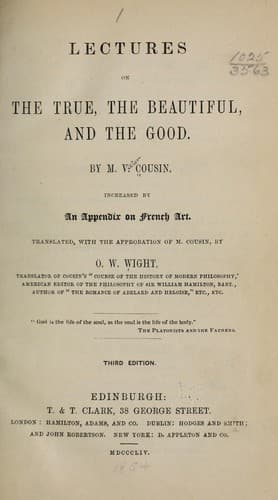
Lectures on the true, the beautiful and the goodCousin, Victor
Philosophy
Lectures on the true, the beautiful and the good
Cousin, Victor
Aesthetics; Ethics; Truth
Let us comprehend well the import of this new discussion. The principles
that govern our judgments, that preside over most sciences, that rule
our actions,--have they in themselves an absolute truth, or are they
only regulating laws of our thought? The question is, to know whether it
is true in itself, that every phenomenon has a cause, and every quality
a subject, whether every thing extended is really in space, and every
succession in time, etc. If it is not absolutely true that every quality
has its subject of inherence, it is not, then, certain, that we have a
soul, a real substance of all the qualities which consciousness
attests. If the principle of causality is only a law of our mind, the
external world, which this principle discovers to us, loses its reality,
it is only a succession of phenomena, without any effective action over
each other, as Hume would have it, and even the impressions of our
senses are destitute of causes. Matter exists no more than the soul.
Nothing exists; every thing is reduced to mobile appearances, given up
to a perpetual becoming, which again is accomplished we know not where,
since in reality there is neither time nor space. Since the principle of
sufficient reason only serves to put in motion human curiosity, once in
possession of the fatal secret that it can attain nothing real, this
curiosity would be very good to weary itself in searching for reasons
which inevitably escape it, and in discovering relations which
correspond only to the wants of our mind, and do not in the least
correspond to the nature of things. In fine, if the principle of
causality, of substances, of final causes, of sufficient reason, are
only our modes of conception, God, whom all these principles reveal to
us, will no more be any thing but the last of chimeras, which vanishes
with all the others in the breath of the Critique.
Kant has established, as well as Reid and ourself, the existence of
universal and necessary principles; but an involuntary disciple of his
century, an unconscious servant of the empirical school, to which he
places himself in the attitude of an adversary, he makes to it the
immense concession that these principles are applied only to the
impressions of sensibility, that their part is to put these impressions
in a certain order, but that beyond these impressions, beyond
experience, their power expires. This concession has ruined the whole
enterprise of the German philosopher.
Public-domain text, read in full here on John Shaqi.
Reviews
Reviews
No reviews yet
Be the first to share your thoughts on this work.
Join the Discussion
Join the discussion
Sign in to leave a comment or review.
Sign InorCreate an account