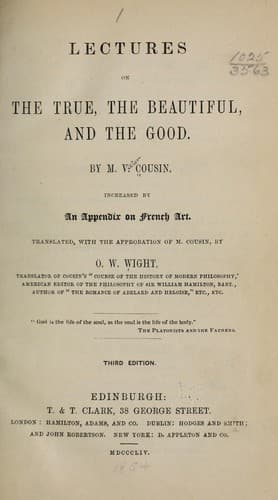
Lectures on the true, the beautiful and the goodCousin, Victor
Philosophy
Lectures on the true, the beautiful and the good
Cousin, Victor
Aesthetics; Ethics; Truth
This enterprise was at once honest and great. Kant, grieved at the
skepticism of his times, proposed to arrest it by fairly meeting it. He
thought to disarm Hume by conceding to him that our highest conceptions
do not extend themselves beyond the inclosure of the human mind; and at
the same time, he supposed that he had sufficiently vindicated the human
mind by restoring to it the universal and necessary principles which
direct it. But, according to the strong expression of M. Royer-Collard,
"one does not encounter skepticism,--as soon as he has penetrated into
the human understanding he has completely taken it by storm." A severe
circumspection is one thing, skepticism is another. Doubt is not only
permitted, it is commanded by reason itself in the employment and
legitimate applications of our different faculties; but when it is
applied to the legitimacy itself of our faculties, it no longer
elucidates reason, it overwhelms it. In fact, with what would you have
reason defend herself, when she has called herself in question? Kant
himself, then, overturned the dogmatism which he proposed at once to
restrain and save, at least in morals, and he put German philosophy upon
a route, at the end of which was an abyss. In vain has this great
man--for his intentions and his character, without speaking of his
genius, merit for him this name--undertaken with Hume an ingenious and
learned controversy; he has been vanquished in this controversy, and
Hume remains master of the field of battle.
What matters it, in fact, whether there may or may not be in the human
mind universal and necessary principles, if these principles only serve
to classify our sensations, and to make us ascend, step by step, to
ideas that are most sublime, but have for ourselves no reality? The
human mind is, then, as Kant himself well expressed it, like a banker
who should take bills ranged in order on his desk for real values;--he
possesses nothing but papers. We have thus returned, then, to that
conceptualism of the middle age, which, concentrating truth within the
human intelligence, makes the nature of things a phantom of intelligence
projecting itself everywhere out of itself, at once triumphant and
impotent, since it produces every thing, and produces only chimeras.[37]
The reproach which a sound philosophy will content itself with making to
Kant, is, that his system is not in accordance with facts. Philosophy
can and must separate itself from the crowd for the explanation of
facts; but, it cannot be too often repeated, it must not in the
explanation destroy what it pretends to explain; otherwise it does not
explain, it imagines. Here, the important fact which it is the question
to explain is the belief of the human mind, and the system of Kant
annihilates it.
Public-domain text, read in full here on John Shaqi.
Reviews
Reviews
No reviews yet
Be the first to share your thoughts on this work.
Join the Discussion
Join the discussion
Sign in to leave a comment or review.
Sign InorCreate an account