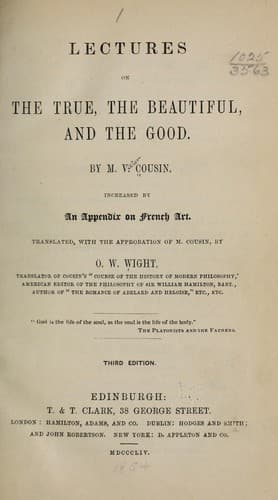
Lectures on the true, the beautiful and the goodCousin, Victor
Philosophy
Lectures on the true, the beautiful and the good
Cousin, Victor
Aesthetics; Ethics; Truth
In fact, when we are speaking of the truth of universal and necessary
principles, we do not believe they are true only for us:--we believe
them to be true in themselves, and still true, were there no minds of
ours to conceive them. We regard them as independent of us; they seem to
us to impose themselves upon our intelligence by the force of the truth
that is in them. So, in order to express faithfully what passes within
us, it would be necessary to reverse the proposition of Kant, and
instead of saying with him, that these principles are the necessary laws
of our mind, therefore they have no absolute value out of mind; we
should much rather say, that these principles have an absolute value in
themselves, therefore we cannot but believe them.
And even this necessity of belief with which the new skepticism arms
itself, is not the indispensable condition of the application of
principles. We have established[38] that the necessity of believing
supposes reflection, examination, an effort to deny and the want of
power to do it; but before all reflection, intelligence spontaneously
seizes the truth, and, in the spontaneous apperception, is not the
sentiment of necessity, nor consequently that character of subjectivity
of which the German school speaks so much.
Let us, then, here recur to that spontaneous intuition of truth, which
Kant knew not, in the circle where his profoundly reflective and
somewhat scholastic habits held him captive.
Is it true that there is no judgment, even affirmative in form, which is
not mixed with negation?
It seems indeed that every affirmative judgment is at the same time
negative; in fact, to affirm that a thing exists, is to deny its
non-existence; as every negative judgment is at the same time
affirmative; for to deny the existence of a thing, is to affirm its
non-existence. If it is so, then every judgment, whatever may be its
form, affirmative or negative, since these two forms come back to each
other, supposes a pre-established doubt in regard to the existence of
the thing in question, supposes some exercise of reflection, in the
course of which the mind feels itself constrained to bear such or such a
judgment, so that at this point of view the foundation of the judgment
seems to be in its necessity; and then recurs the celebrated
objection:--if you judge thus only because it is impossible for you not
to do it, you have for a guaranty of the truth nothing but yourself and
your own ways of conceiving; it is the human mind that transports its
laws out of itself; it is the subject that makes the object out of its
own image, without ever going beyond the inclosure of subjectivity.
Public-domain text, read in full here on John Shaqi.
Reviews
Reviews
No reviews yet
Be the first to share your thoughts on this work.
Join the Discussion
Join the discussion
Sign in to leave a comment or review.
Sign InorCreate an account