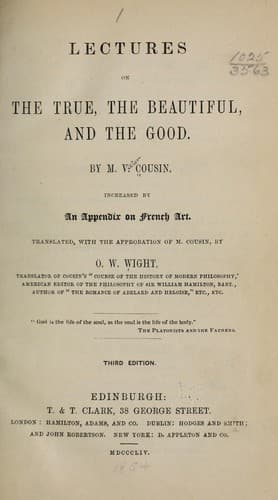
Lectures on the true, the beautiful and the goodCousin, Victor
Philosophy
Lectures on the true, the beautiful and the good
Cousin, Victor
Aesthetics; Ethics; Truth
We respond, going directly to the root of the difficulty:--it is not
true that all our judgments are negative. We admit that in the
reflective state every affirmative judgment supposes a negative
judgment, and reciprocally. But is reason exercised only on the
condition of reflection? Is there not a primitive affirmation which
implies no negation? As we often act without deliberating on our action,
without premeditating it, and as we manifest in this case an activity
that is free still, but free with a liberty that is not reflective; so
reason often perceives the truth without traversing doubt or error.
Reflection is a return to consciousness, or to an operation wholly
different from it. We do not find, then, in any primitive fact, that
every judgment which contains it presupposes another in which it is not.
We thus arrive at a judgment free from all reflection, to an affirmation
without any mixture of negation, to an immediate intuition, the
legitimate child of the natural energy of thought, like the inspiration
of the poet, the instinct of the hero, the enthusiasm of the prophet.
Such is the first act of the faculty of knowing. If one contradicts this
primitive affirmation, the faculty of knowing falls back up upon itself,
examines itself, attempts to call in doubt the truth it has perceived;
it cannot; it affirms anew what it had affirmed at first; it adheres to
the truth already recognized, but with a new sentiment, the sentiment
that it is not in its power to divest itself of the evidence of this
same truth; then, but only then, appears that character of necessity and
subjectivity that some would turn against the truth, as though truth
could lose its own value, while penetrating deeper into the mind and
there triumphing over doubt; as though reflective evidence of it were
the less evidence; as though, moreover, the necessary conception of it
were the only form, the primary form of the perception of truth. The
skepticism of Kant, to which good sense so easily does justice, is
driven to the extreme and forced within its intrenchment by the
distinction between spontaneous reason and reflective reason. Reflection
is the theatre of the combats which reason engages in with itself, with
doubt, sophism, and error. But above reflection is a sphere of light and
peace, where reason perceives truth without returning on itself, for the
sole reason that truth is truth, and because God has made the reason to
perceive it, as he has made the eye to see and the ear to hear.
Public-domain text, read in full here on John Shaqi.
Reviews
Reviews
No reviews yet
Be the first to share your thoughts on this work.
Join the Discussion
Join the discussion
Sign in to leave a comment or review.
Sign InorCreate an account