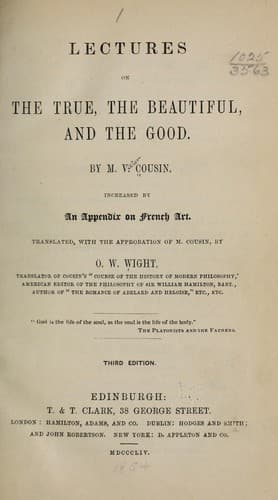
Lectures on the true, the beautiful and the goodCousin, Victor
Philosophy
Lectures on the true, the beautiful and the good
Cousin, Victor
Aesthetics; Ethics; Truth
Analyze, in fact, with impartiality, the fact of spontaneous
apperception, and you will be sure that it has nothing subjective in it
except what it is impossible it should not have, to wit, the _me_ which is
mingled with the fact without constituting it. The _me_ inevitably enters
into all knowledge, since it is the subject of it. Reason directly
perceives truth; but it is in some sort augmented, in consciousness, and
then we have knowledge. Consciousness is there its witness, and not its
judge; its only judge is reason, a faculty subjective and objective
together, according to the language of Germany, which immediately
attains absolute truth, almost without personal intervention on our
part, although it might not enter into exercise if personality did not
precede or were not added to it.[39]
Spontaneous apperception constitutes natural logic. Reflective
conception is the foundation of logic properly so called. One is based
upon itself, _verum index sui_; the other is based upon the
impossibility of the reason, in spite of all its efforts, not betaking
itself to truth and believing in it. The form of the first is an
affirmation accompanied with an absolute security, and without the least
suspicion of a possible negation; the form of the second is reflective
affirmation, that is to say, the impossibility of denying and the
necessity of affirming. The idea of negation governs ordinary logic,
whose affirmations are only the laborious product of two negations.
Natural logic proceeds by affirmations stamped with a simple faith,
which instinct alone produces and sustains.
Public-domain text, read in full here on John Shaqi.
Reviews
Reviews
No reviews yet
Be the first to share your thoughts on this work.
Join the Discussion
Join the discussion
Sign in to leave a comment or review.
Sign InorCreate an account