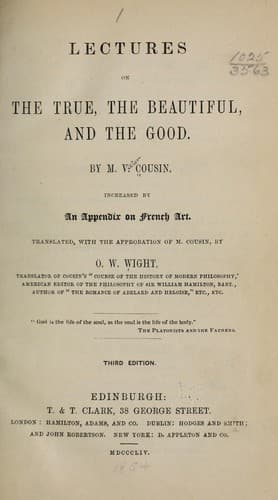
Lectures on the true, the beautiful and the goodCousin, Victor
Philosophy
Lectures on the true, the beautiful and the good
Cousin, Victor
Aesthetics; Ethics; Truth
Now, will Kant reply that this reason, which is much purer than that
which he has known and described, which is wholly pure, which is
conceived as something disengaged from reflection, from volition, from
every thing that constitutes personality, is nevertheless personal,
since we have a consciousness of it, and since it is thus marked with
subjectivity? To this argument we have nothing to respond, except that
it is destroyed in the excess of its pretension. In fact, if, that
reason may not be subjective, we must in no way participate in it, and
must not have even a consciousness of its exercise, then there is no
means of ever escaping this reproach of subjectivity, and the ideal of
objectivity which Kant pursued is a chimerical, extravagant ideal,
above, or rather beneath, all true intelligence, all reason worthy the
name; for it is demanding that this intelligence and this reason should
cease to have consciousness of themselves, whilst this is precisely what
characterizes intelligence and reason.[40] Does Kant mean, then, that
reason, in order to possess a really objective power, cannot make its
appearance in a particular subject, that it must be, for example, wholly
outside of the subject which I am? Then it is nothing for me; a reason
that is not mine, that, under the pretext of being universal, infinite,
and absolute in its essence, does not fall under the perception of my
consciousness, is for me as if it were not. To wish that reason should
wholly cease to be subjective, is to demand something impossible to God
himself. No, God himself can understand nothing except in knowing it,
with his intelligence and with the consciousness of this intelligence.
There is subjectivity, then, in divine knowledge itself; if this
subjectivity involves skepticism, God is also condemned to skepticism,
and he can no more escape from it than men; or indeed, if this is too
ridiculous, if the knowledge which God has of the exercise of his own
intelligence does not involve skepticism for him, neither do the
knowledge which we have of the exercise of our intelligence, and the
subjectivity attached to this knowledge, involve it for us.
Public-domain text, read in full here on John Shaqi.
Reviews
Reviews
No reviews yet
Be the first to share your thoughts on this work.
Join the Discussion
Join the discussion
Sign in to leave a comment or review.
Sign InorCreate an account