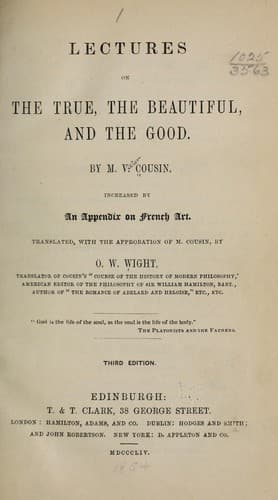
Lectures on the true, the beautiful and the goodCousin, Victor
Philosophy
Lectures on the true, the beautiful and the good
Cousin, Victor
Aesthetics; Ethics; Truth
In truth, when we see the father of German philosophy thus losing
himself in the labyrinth of the problem of the subjectivity and the
objectivity of first principles, we are tempted to pardon Reid for
having disdained this problem, for limiting himself to repeating that
the absolute truth of universal and necessary principles rests upon the
veracity of our faculties, and that upon the veracity of our faculties
we are compelled to accept their testimony. "To explain," says he, "why
we are convinced by our senses, by consciousness, by our faculties, is
an impossible thing; we say--this is so, it cannot be otherwise, and we
can go no farther. Is not this the expression of an irresistible belief,
of a belief which is the voice of nature, and against which we contend
in vain? Do we wish to penetrate farther, to demand of our faculties,
one by one, what are their titles to our confidence, and to refuse them
confidence until they have produced their claims? Then, I fear that this
extreme wisdom would conduct us to folly, and that, not having been
willing to submit to the common lot of humanity, we should be deprived
of the light of common sense."[41]
Let us support ourselves also by the following admirable passage of him
who is, for so many reasons, the venerated master of the French
philosophy of the nineteenth century. "Intellectual life," says M.
Royer-Collard, "is an uninterrupted succession, not only of ideas, but
of explicit or implicit beliefs. The beliefs of the mind are the powers
of the soul and the motives of the will. That which determines us to
belief we call evidence. Reason renders no account of evidence; to
condemn reason to account for evidence, is to annihilate it, for it
needs itself an evidence which is fitted for it. These are fundamental
laws of belief which constitute intelligence, and as they flow from the
same source they have the same authority; they judge by the same right;
there is no appeal from the tribunal of one to that of another. He who
revolts against a single one revolts against all, and abdicates his
whole nature."[42]
Let us deduce the consequences of the facts of which we have just given
an exposition.
1st. The argument of Kant, which is based upon the character of
necessity in principles in order to weaken their objective authority,
applies only to the form imposed by reflection on these principles, and
does not reach their spontaneous application, wherein the character of
necessity no longer appears.
2d. After all, to conclude with the human race from the necessity of
believing in the truth of what we believe, is not to conclude badly; for
it is reasoning from effect to cause, from the sign to the thing
signified.
Public-domain text, read in full here on John Shaqi.
Reviews
Reviews
No reviews yet
Be the first to share your thoughts on this work.
Join the Discussion
Join the discussion
Sign in to leave a comment or review.
Sign InorCreate an account