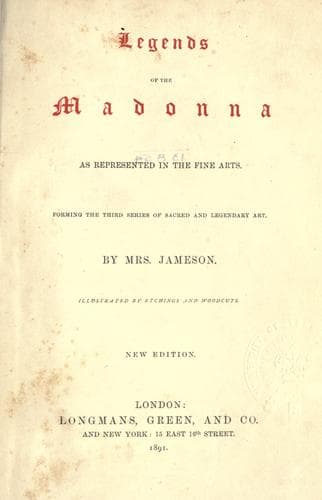
Legends of the Madonna as Represented in the Fine ArtsJameson, Mrs. (Anna)
Religion
Legends of the Madonna as Represented in the Fine Arts
Jameson, Mrs. (Anna)
Christian saints in art; Mary, Blessed Virgin, Saint -- Art; Mary, Blessed Virgin, Saint -- Legends
Gerson, a celebrated French priest, and chancellor of the university
of Paris, distinguished himself in the Council of Constance by the
eloquence with which he pleaded for the Immaculate Conception, and the
enthusiasm with which he preached in favour of instituting a festival
in honour of this mystery, as well as another in honour of Joseph,
the husband of the Virgin. In both he was unsuccessful during his
lifetime; but for both eventually his writings prepared the way.
He also composed a Latin poem of three thousand lines in praise of
Joseph, which was among the first works published after the invention
of printing. Together with St. Joseph, the parents of the Virgin, St.
Anna more particularly, became objects, of popular veneration, and
all were at length exalted to the rank of patron saints, by having
festivals instituted in their honour. It is towards the end of the
fifteenth century, or rather a little later, that we first meet with
that charming domestic group, called the "Holy Family," afterwards
so popular, so widely diffused, and treated with such an infinite
variety.
* * * * *
Towards the end of this century sprung up a new influence,--the
revival of classical learning, a passionate enthusiasm for the poetry
and mythology of the Greeks, and a taste for the remains of antique
art. This influence on the representations of the Virgin, as far as
it was merely external, was good. An added dignity and grace, a more
free and correct drawing, a truer feeling for harmony of proportion
and all that constitutes elegance, were gradually infused into the
forms and attitudes. But dangerous became the craving for mere
beauty,--dangerous the study of the classical and heathen literature.
This was the commencement of that thoroughly pagan taste which in
the following century demoralized Christian art. There was now an
attempt at varying the arrangement of the sacred groups which led to
irreverence, or at best to a sort of superficial mannered grandeur;
and from this period we date the first introduction of the portrait
Virgins. An early, and most scandalous example remains to us in one
of the frescoes in the Vatican, which represents Giulia Farnese in the
character of the Madonna, and Pope Alexander VI. (the infamous Borgia)
kneeling at her feet in the character of a votary. Under the influence
of the Medici the churches of Florence were filled with pictures of
the Virgin, in which the only thing aimed at was an alluring and
even meretricious beauty. Savonarola thundered from his pulpit in the
garden of San Marco against these impieties. He exclaimed against
the profaneness of those who represented the meek mother of Christ in
gorgeous apparel, with head unveiled, and under the features of women
too well and publicly known. He emphatically declared that if the
painters knew as well as he did the influence of such pictures in
perverting simple minds, they would hold their own works in horror and
detestation.
Public-domain text, read in full here on John Shaqi.
Reviews
Reviews
No reviews yet
Be the first to share your thoughts on this work.
Join the Discussion
Join the discussion
Sign in to leave a comment or review.
Sign InorCreate an account