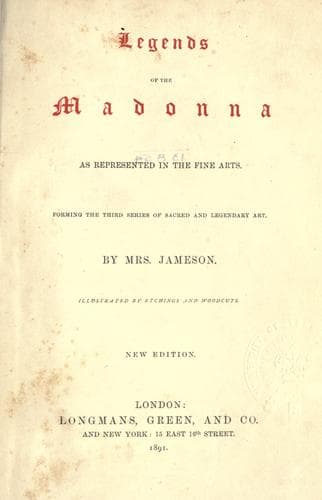
Legends of the Madonna as Represented in the Fine ArtsJameson, Mrs. (Anna)
Religion
Legends of the Madonna as Represented in the Fine Arts
Jameson, Mrs. (Anna)
Christian saints in art; Mary, Blessed Virgin, Saint -- Art; Mary, Blessed Virgin, Saint -- Legends
Savonarola yielded to none in orthodox reverence for the
Madonna; but he desired that she should be represented in an orthodox
manner. He perished at the stake, but not till after he had made
a bonfire in the Piazza at Florence of the offensive effigies; he
perished--persecuted to death by the Borgia family. But his influence
on the greatest Florentine artists of his time is apparent in the
Virgins of Botticelli, Lorenzo di Credi, and Fra Bartolomeo, all of
whom had been his friends, admirers, and disciples: and all, differing
from each other, were alike in this, that, whether it be the dignified
severity of Botticelli, or the chaste simplicity of Lorenzo di Credi,
or the noble tenderness of Fra Bartolomeo, we feel that each of them
had aimed to portray worthily the sacred character of the Mother of
the Redeemer. And to these, as I think, we might add Raphael himself,
who visited Florence but a short time after the horrible execution
of Savonarola, and must have learned through his friend Bartolomeo to
mourn the fate and revere the memory of that remarkable man, whom he
placed afterwards in the grand fresco of the "Theologia," among the
doctors and teachers of the Church. (Rome, Vatican.) Of the numerous
Virgins painted by Raphael in after times, not one is supposed to have
been a portrait: he says himself, in a letter to Count Castiglione,
that he painted from an idea in his own mind, "mi servo d' una certa
idea che mi viene in mente;" while in the contemporary works of Andrea
del Sarto, we have the features of his handsome but vulgar wife in
every Madonna he painted.[1]
[Footnote 1: The tendency to portraiture, in early Florentine and
German art, is observable from an early period. The historical sacred
subjects of Masaccio, Ghirlandajo, and Van Eyck, are crowded with
portraits of living personages. Their introduction into devotional
subjects, in the character of sacred persons, is far less excusable.]
Public-domain text, read in full here on John Shaqi.
Reviews
Reviews
No reviews yet
Be the first to share your thoughts on this work.
Join the Discussion
Join the discussion
Sign in to leave a comment or review.
Sign InorCreate an account