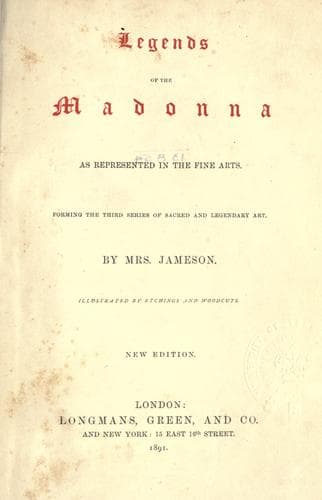
Legends of the Madonna as Represented in the Fine ArtsJameson, Mrs. (Anna)
Religion
Legends of the Madonna as Represented in the Fine Arts
Jameson, Mrs. (Anna)
Christian saints in art; Mary, Blessed Virgin, Saint -- Art; Mary, Blessed Virgin, Saint -- Legends
In the beginning of the sixteenth century, the constellation of living
genius in every department of art, the riches of the Church, the
luxurious habits and classical studies of the churchmen, the decline
of religious conviction, and the ascendency of religious controversy,
had combined to multiply church pictures, particularly those of a
large and decorative character. But, instead of the reign of faith,
we had now the reign of taste. There was an absolute passion for
picturesque grouping; and, as the assembled figures were to be as
varied as possible in action and attitude, the artistic treatment, in
order to prevent the lines of form and the colours of the draperies
from interfering with each other, required great skill and profound
study: some of these scenic groups have become, in the hands of great
painters, such as Titian, Paul Veronese, and Annibale Caracci, so
magnificent, that we are inclined to forgive their splendid errors.
The influence of Sanazzaro, and of his famous Latin poem on the
Nativity ("_De Partu Virginis_"), on the artists of the middle of the
sixteenth century, and on the choice and treatment of the subjects
pertaining to the Madonna, can hardly be calculated; it was like that
of Dante in the fourteenth century, but in its nature and result how
different! The grand materialism of Michael Angelo is supposed to have
been allied to the genius of Dante; but would Dante have acknowledged
the group of the Holy Family in the Florentine Gallery, to my feeling,
one of the most profane and offensive of the so-called _religious_
pictures, in conception and execution, which ever proceeded from
the mind or hand of a great painter? No doubt some of the sculptural
Virgins of Michael Angelo are magnificent and stately in attitude and
expression, but too austere and mannered as religious conceptions: nor
can we wonder if the predilection for the treatment of mere form led
his followers and imitators into every species of exaggeration and
affectation. In the middle of the sixteenth century, the same artist
who painted a Leda, or a Psyche, or a Venus one day, painted for the
same patron a Virgin of Mercy, or a "Mater Purissima" on the morrow.
_Here_, the votary told his beads, and recited his Aves, before
the blessed Mother of the Redeemer; _there_, she was invoked in
the purest Latin by titles which the classical mythology had far
otherwise consecrated. I know nothing more disgusting in art than the
long-limbed, studied, inflated Madonnas, looking grand with all their
might, of this period; luckily they have fallen into such disrepute
that we seldom see them. The "Madonna dell' lungo Collo" of Parmigiano
might be cited as a favourable example of this mistaken and wholly
artificial grace. (Florence, Pitti Pal.)
Public-domain text, read in full here on John Shaqi.
Reviews
Reviews
No reviews yet
Be the first to share your thoughts on this work.
Join the Discussion
Join the discussion
Sign in to leave a comment or review.
Sign InorCreate an account