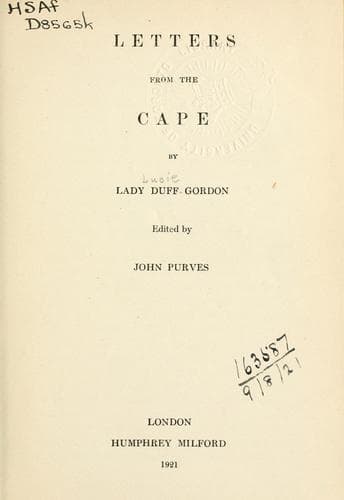
Cape of Good Hope (South Africa) -- Description and travel
When I have done my visit to Simon’s Bay, I will go ‘up country’, to
Stellenbosch, Paarl and Worcester, perhaps. If I can find people going
in a bullock-waggon, I will join them; it costs £1 a day, and goes twenty
miles. If money were no object, I would hire one with Caffres to hunt,
as well as outspan and drive, and take a saddle-horse. There is plenty
of pleasure to be had in travelling here, if you can afford it. The
scenery is quite beyond anything you can imagine in beauty. I went to a
country house at Rondebosch with the J—s, and I never saw so lovely a
spot. The possessor had done his best to spoil it, and to destroy the
handsome Dutch house and fountains and aqueducts; but Nature was too much
for him, and the place lovely in neglect and shabbiness.
Now I will tell you my impressions of the state of society here, as far
as I have been able to make out by playing the inquisitive traveller. I
dare say the statements are exaggerated, but I do not think they are
wholly devoid of truth. The Dutch round Capetown (I don’t know anything
of ‘up country’) are sulky and dispirited; they regret the slave days,
and can’t bear to pay wages; they have sold all their fine houses in town
to merchants, &c., and let their handsome country places go to pieces,
and their land lie fallow, rather than hire the men they used to own.
They hate the Malays, who were their slaves, and whose ‘insolent
prosperity’ annoys them, and they don’t like the vulgar, bustling
English. The English complain that the Dutch won’t die, and that they
are the curse of the colony (a statement for which they can never give a
reason). But they, too, curse the emancipation, long to flog the
niggers, and hate the Malays, who work harder and don’t drink, and who
are the only masons, tailors, &c., and earn from 4_s._ 6_d._ to 10_s._ a
day. The Malays also have almost a monopoly of cart-hiring and
horse-keeping; an Englishman charges £4 10_s._ or £5 for a carriage to do
what a Malay will do quicker in a light cart for 30_s._ S— says, ‘The
English here think the coloured people ought to do the work, and they to
get the wages. Nothing less would satisfy them.’ Servants’ wages are
high, but other wages not much higher than in England; yet industrious
people invariably make fortunes, or at least competencies, even when they
begin with nothing. But few of the English will do anything but lounge;
while they abuse the Dutch as lazy, and the Malays as thieves, and feel
their fingers itch to be at the blacks. The Africanders (Dutch and negro
mixed in various proportions) are more or less lazy, dirty, and dressy,
and the beautiful girls wear pork-pie hats, and look very winning and
rather fierce; but to them the philanthropists at home have provided
formidable rivals, by emptying a shipload of young ladies from a
‘Reformatory’ into the streets of Capetown.
Public-domain text, read in full here on John Shaqi.
Reviews
Reviews
No reviews yet
Be the first to share your thoughts on this work.
Join the Discussion
Join the discussion
Sign in to leave a comment or review.
Sign InorCreate an account