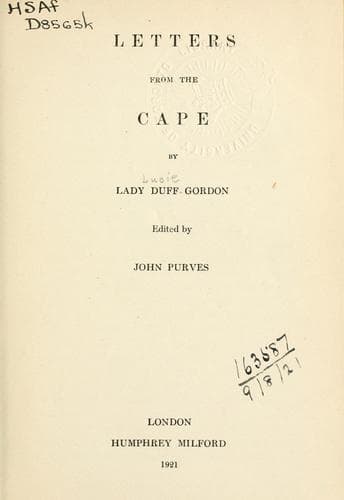
Cape of Good Hope (South Africa) -- Description and travel
Such letters cannot be expected to be free from mistakes. The writer is
misinformed; or her imagination, powerfully acted upon by new and strange
objects, colours and magnifies, to a certain extent, what she sees. If
these are valid objections, they are equally so to every description of a
country that has not been corrected by long experience.
It has been thought, however, that their obvious and absolute
genuineness, and a certain frank and high-toned originality, hardly to be
found in what is written for the public, would recommend them to the
taste of many.
But this was not the strongest motive to their publication.
The tone of English travellers is too frequently arrogant and
contemptuous, even towards peoples whose pretensions on the score of
civilization are little inferior to their own. When they come in contact
with communities or races inferior to them in natural organization or in
acquired advantages, the feeling of a common humanity often seems
entirely to disappear. No attempt is made to search out, under external
differences, the proofs of a common nature; no attempt to trace the
streams of human affections in their course through channels unlike those
marked out among ourselves; no attempt to discover what there may be of
good mingled with obvious evil, or concealed under appearances which
excite our surprise and antipathy.
It is the entire absence of the exclusive and supercilious spirit which
characterizes dominant races; the rare power of entering into new trains
of thought, and sympathizing with unaccustomed feelings; the tender pity
for the feeble and subject, and the courteous respect for their
prejudices; the large and purely human sympathies;—these, far more than
any literary or graphic merits, are the qualities which have induced the
possessors of the few following letters to give them to the public.
They show, what a series of letters from Egypt, since received from the
same writer, prove yet more conclusively; that even among so-called
barbarians are to be found hearts that open to every touch of kindness,
and respond to every expression of respect and sympathy.
If they should awaken any sentiments like those which inspired them, on
behalf of races of men who come in contact with civilization only to feel
its resistless force and its haughty indifference or contempt, it will be
some consolation to those who are enduring the bitterness of the
separation to which they owe their existence.
SARAH AUSTIN.
WEYBRIDGE,
_Feb._ 24, 1864.
LETTER I
THE VOYAGE
Wednesday, 24th July.
Off the Scilly Isles, 6 P.M.
Public-domain text, read in full here on John Shaqi.
Reviews
Reviews
No reviews yet
Be the first to share your thoughts on this work.
Join the Discussion
Join the discussion
Sign in to leave a comment or review.
Sign InorCreate an account