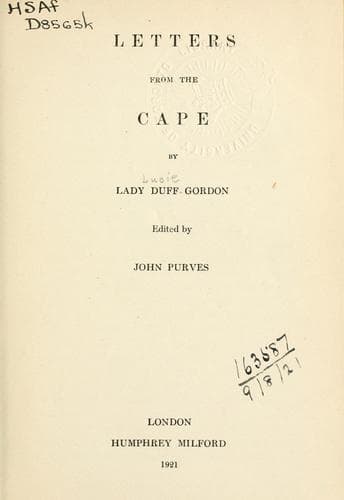
Cape of Good Hope (South Africa) -- Description and travel
Caffre language (I’ve got it for Dr. Hawtrey,)—extracts from the New
Testament,—and I made them read the sheets they were going to bind; it is
a beautiful language, like Spanish in tone, only with a queer ‘click’ in
it. The boys drew, like Chinese, from ‘copies’, and wrote like
copper-plate; they sang some of Mendelssohn’s choruses from ‘St. Paul’
splendidly, the Caffres rolling out soft rich bass voices, like melodious
thunder. They are clever at handicrafts, and fond of geography and
natural history, incapable of mathematics, quick at languages, utterly
incurious about other nations, and would all rather work in the fields
than learn anything but music; good boys, honest, but ‘_trotzig_’. So
much for Caffres, Fingoes, &c. The Bastaards are as clever as whites,
and more docile—so the ‘rector’ told me. The boy who played the organ
sang the ‘Lorelei’ like an angel, and played us a number of waltzes and
other things on the piano, but he was too shy to talk; while the Caffres
crowded round me, and chattered away merrily. The Mantatees, whom I
cannot distinguish from Caffres, are scattered all over the colony, and
rival the English as workmen and labourers—fine stalwart, industrious
fellows. Our little ‘boy’ Kleenboy hires a room for fifteen shillings a
month, and takes in his compatriots as lodgers at half a crown a week—the
usurious little rogue! His chief, one James, is a bricklayer here, and
looks and behaves like a prince. It is fine to see his black arms,
ornamented with silver bracelets, hurling huge stones about.
Public-domain text, read in full here on John Shaqi.
Reviews
Reviews
No reviews yet
Be the first to share your thoughts on this work.
Join the Discussion
Join the discussion
Sign in to leave a comment or review.
Sign InorCreate an account