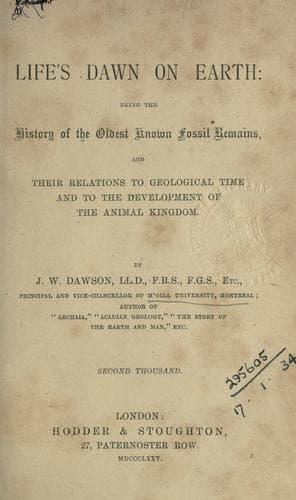
Life's Dawn on Earth: Being the history of the oldest known fossil remains, and their relations to geological time and to the development of the animal kingdom — John Shaqi
Life's Dawn on Earth: Being the history of the oldest known fossil remains, and their relations to geological time and to the development of the animal kingdomDawson, John William, Sir
History
Life's Dawn on Earth: Being the history of the oldest known fossil remains, and their relations to geological time and to the development of the animal kingdom
Dawson, John William, Sir
Life -- Origin; Paleontology -- Precambrian
"In both the Upper and Lower Laurentian series there are several
zones of limestone, each of sufficient volume to constitute an
independent formation. Of these calcareous masses it has been
ascertained that three, at least, belong to the Lower Laurentian. But
as we do not as yet know with certainty either the base or the summit
of this series, these three may be conformably followed by many more.
Although the Lower and Upper Laurentian rocks spread over more than
200,000 square miles in Canada, only about 1500 square miles have yet
been fully and connectedly examined in any one district, and it is
still impossible to say whether the numerous exposures of Laurentian
limestone met with in other parts of the province are equivalent to
any of the three zones, or whether they overlie or underlie them all."
(B.) Dr. Sterry Hunt on the Probable Existence of Life in the
Laurentian Period.
Dr. Hunt's views on this subject were expressed in the _American
Journal of Science_, [2], vol. xxxi., p. 395. From this article,
written in 1861, after the announcement of the existence of laminated
forms supposed to be organic in the Laurentian, by Sir W. E. Logan,
but before their structure and affinities had been ascertained, I
quote the following sentences:--
"We see in the Laurentian series beds and veins of metallic
sulphurets, precisely as in more recent formations; and the extensive
beds of iron ore, hundreds of feet thick, which abound in that
ancient system, correspond not only to great volumes of strata
deprived of that metal, but, as we may suppose, to organic matters
which, but for the then great diffusion of iron-oxyd in conditions
favourable for their oxidation, might have formed deposits of mineral
carbon far more extensive than those beds of plumbago which we
actually meet in the Laurentian strata. All these conditions lead us
then to conclude the existence of an abundant vegetation during the
Laurentian period."
(C.) The Graphite of the Laurentian.
The following is from a paper by the author, in the _Journal of the
Geological Society_, for February, 1870:--
Public-domain text, read in full here on John Shaqi.
Reviews
Reviews
No reviews yet
Be the first to share your thoughts on this work.
Join the Discussion
Join the discussion
Sign in to leave a comment or review.
Sign InorCreate an account