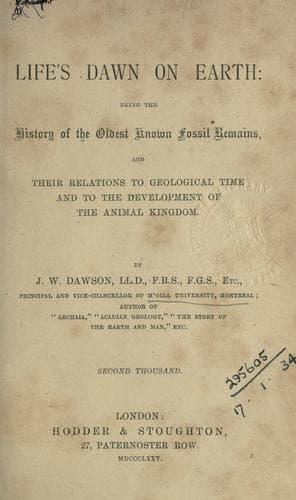
Life's Dawn on Earth: Being the history of the oldest known fossil remains, and their relations to geological time and to the development of the animal kingdomDawson, John William, Sir
History
Life's Dawn on Earth: Being the history of the oldest known fossil remains, and their relations to geological time and to the development of the animal kingdom
Dawson, John William, Sir
Life -- Origin; Paleontology -- Precambrian
"The graphite of the Laurentian of Canada occurs both in beds and in
veins, and in such a manner as to show that its origin and deposition
are contemporaneous with those of the containing rock. Sir William
Logan states[D] that 'the deposits of plumbago generally occur in the
limestones or in their immediate vicinity, and granular varieties
of the rock often contain large crystalline plates of plumbago. At
other times this mineral is so finely disseminated as to give a
bluish-gray colour to the limestone, and the distribution of bands
thus coloured, seems to mark the stratification of the rock.' He
further states:--'The plumbago is not confined to the limestones;
large crystalline scales of it are occasionally disseminated in
pyroxene rock or pyrallolite, and sometimes in quartzite and in
feldspathic rocks, or even in magnetic oxide of iron.' In addition
to these bedded forms, there are also true veins in which graphite
occurs associated with calcite, quartz, orthoclase, or pyroxene,
and either in disseminated scales, in detached masses, or in
bands or layers 'separated from each other and from the wall rock
by feldspar, pyroxene, and quartz.' Dr. Hunt also mentions the
occurrence of finely granular varieties, and of that peculiarly
waved and corrugated variety simulating fossil wood, though really a
mere form of laminated structure, which also occurs at Warrensburgh,
New York, and at the Marinski mine in Siberia. Many of the veins
are not true fissures, but rather constitute a network of shrinkage
cracks or segregation veins traversing in countless numbers the
containing rock, and most irregular in their dimensions, so that
they often resemble strings of nodular masses. It has been supposed
that the graphite of the veins was originally introduced as a liquid
hydrocarbon. Dr. Hunt, however, regards it as possible that it
may have been in a state of aqueous solution;[E] but in whatever
way introduced, the character of the veins indicates that in the
case of the greater number of them the carbonaceous material must
have been derived from the bedded rocks traversed by these veins,
while there can be no doubt that the graphite found in the beds has
been deposited along with the calcareous matter or muddy and sandy
sediment of which these beds were originally composed.
[Footnote D: _Geology of Canada_, 1863.]
[Footnote E: _Report of the Geological Survey of Canada_, 1866.]
Public-domain text, read in full here on John Shaqi.
Reviews
Reviews
No reviews yet
Be the first to share your thoughts on this work.
Join the Discussion
Join the discussion
Sign in to leave a comment or review.
Sign InorCreate an account