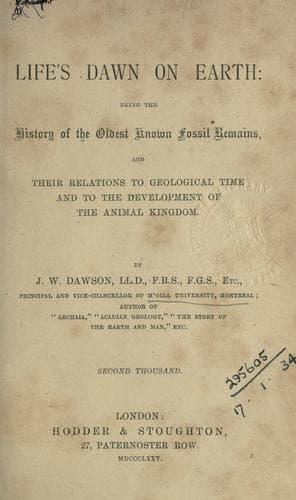
Life's Dawn on Earth: Being the history of the oldest known fossil remains, and their relations to geological time and to the development of the animal kingdomDawson, John William, Sir
History
Life's Dawn on Earth: Being the history of the oldest known fossil remains, and their relations to geological time and to the development of the animal kingdom
Dawson, John William, Sir
Life -- Origin; Paleontology -- Precambrian
"The quantity of graphite in the Lower Laurentian series is enormous.
In a recent visit to the township of Buckingham, on the Ottawa
River, I examined a band of limestone believed to be a continuation
of that described by Sir W. E. Logan as the Green Lake Limestone.
It was estimated to amount, with some thin interstratified bands
of gneiss, to a thickness of 600 feet or more, and was found to
be filled with disseminated crystals of graphite and veins of the
mineral to such an extent as to constitute in some places one-fourth
of the whole; and making every allowance for the poorer portions,
this band cannot contain in all a less vertical thickness of pure
graphite than from twenty to thirty feet. In the adjoining township
of Lochaber Sir W. E. Logan notices a band from twenty-five to thirty
feet thick, reticulated with graphite veins to such an extent as
to be mined with profit for the mineral. At another place in the
same district a bed of graphite from ten to twelve feet thick, and
yielding twenty per cent. of the pure material, is worked. When it
is considered that graphite occurs in similar abundance at several
other horizons, in beds of limestone which have been ascertained by
Sir W. E. Logan to have an aggregate thickness of 3500 feet, it is
scarcely an exaggeration to maintain that the quantity of carbon in
the Laurentian is equal to that in similar areas of the Carboniferous
system. It is also to be observed that an immense area in Canada
appears to be occupied by these graphitic and Eozoon limestones, and
that rich graphitic deposits exist in the continuation of this system
in the State of New York, while in rocks believed to be of this age
near St. John, New Brunswick, there is a very thick bed of graphitic
limestone, and associated with it three regular beds of graphite,
having an aggregate thickness of about five feet.[F]
[Footnote F: Matthew, in _Quart. Journ. Geol. Soc._, vol. xxi., p. 423.
_Acadian Geology_, p. 662.]
Public-domain text, read in full here on John Shaqi.
Reviews
Reviews
No reviews yet
Be the first to share your thoughts on this work.
Join the Discussion
Join the discussion
Sign in to leave a comment or review.
Sign InorCreate an account